
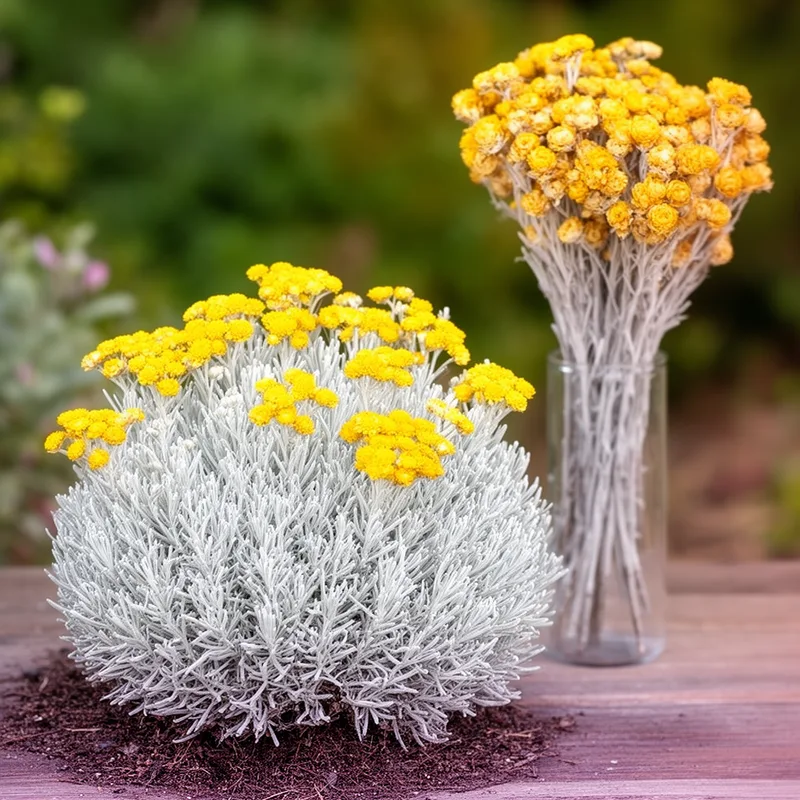
Helichrysum secundiflorum
- noun
- Specialized
- The silver foliage of Helichrysum secundiflorum contrasts beautifully with its bright yellow flowers.
Examples
-
Dried arrangements made with Helichrysum secundiflorum can last for months without losing their scent.
-
The Helichrysum secundiflorum blooms beautifully in summer.
-
Helichrysum secundiflorum is often prized by gardeners for its fragrant, woolly flowers.
-
I bought some Helichrysum secundiflorum for my garden.
-
Helichrysum secundiflorum is often prized by gardeners for its fragrant, woolly flowers.
-
Dried arrangements made with Helichrysum secundiflorum can last for months without losing their scent.
-
The Helichrysum secundiflorum blooms beautifully in summer, adding a lovely fragrance to the garden.
Synonyms

A small shrub with white woolly leaves and long sprays of fragrant flowers used for drying

A small bush with woolly white leaves and long sprays of fragrant flowers that dry well
Surface Forms
Morphology
Helichrysum + secundiflorum
This is a Latin taxonomic binomial (a species name) rather than a compositional English phrase: 'Helichrysum' may signal a plant genus but 'secundiflorum' is not an English word and has no dictionary gloss here. A B1 learner who knows the listed constituents would at best infer it is some kind of plant species but would not be able to derive the specific meaning (a shrub with woolly branches and fragrant flowers), so the expression is not transparently interpretable.
Etymology
Helichrysum secundiflorum may come from old Greek and Latin words: Helichrysum means 'sun-gold' and secundiflorum means 'flowers on one side'. So the name gives a picture of a silver, woolly shrub with bright yellow 'sun-gold' blooms often on one side, which helps explain why gardeners use it for dried arrangements.

