
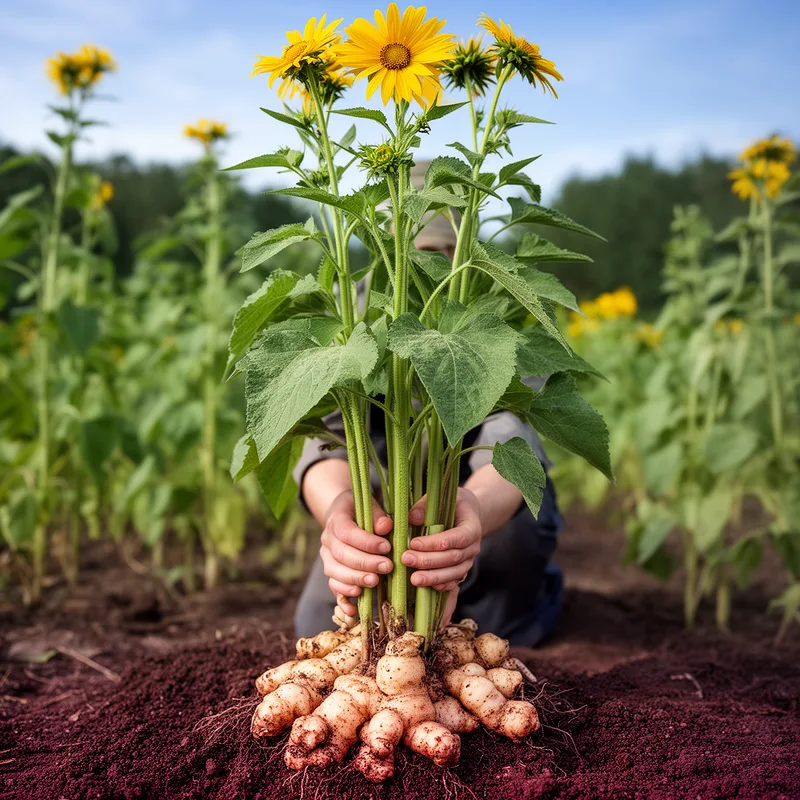
Helianthus tuberosus
- noun
- /ˌhiːliˈænθəs ˌtjuːbəˈroʊsəs/
- Specialized
- Farmers often grow Helianthus tuberosus for its nutritious, knobby tubers known as Jerusalem artichokes.
Examples
-
The leaves of Helianthus tuberosus are rough and hairy, similar to those of other sunflowers.
-
Researchers study Helianthus tuberosus because its tubers are resistant to frost and can be harvested in winter.
-
The Helianthus tuberosus is often grown in gardens.
-
Have you ever tasted Helianthus tuberosus?
-
Farmers often grow Helianthus tuberosus for its large, edible tubers, commonly called Jerusalem artichokes.
-
Researchers study Helianthus tuberosus because its tubers provide a nutritious food source even in winter.
-
The Helianthus tuberosus plant features tall, hairy stems and leaves, making it distinctive in the garden.
Synonyms


 1
7.7
1
7.7
A plant with knobby edible roots eaten as a vegetable

A tall plant with knobby edible tubers grown for food

A tall plant with edible knobby roots that people eat like potatoes, also called Jerusalem artichoke
Surface Forms
Morphology
Helianthus + tuberosus
This is a Latin binomial combining the genus name Helianthus (sunflower group) with the epithet tuberosus (literally 'tuberous' / bearing tubers). If a learner knows both constituents, the meaning 'a Helianthus species that has tubers (i.e. a tuberous sunflower / Jerusalem artichoke)' is directly derivable, and the genus+epithet logic is cross-linguistically regular in scientific names.
Etymology
Helianthus tuberosus comes from Latin words that describe the plant. Helianthus means 'sunflower' because its flower looks like the sun, and tuberosus points to the knobby underground 'tubers' people eat. So the name literally says it is a sunflower with edible tubers, the parts often called 'Jerusalem artichokes'.