
Haredi
 2
9.9
2
9.9

- noun
- /hɑːˈreɪdi/
- There have been many widely distributed condemnations in Hebrew and English from very prominent Haredi leaders.
- ultra-Orthodox Haredi
- Orthodox Haredi
Examples
-
Many Haredi families prioritize religious education for their children above formal schooling.
-
Housing for the religious has increased; the budget for haredi school systems has doubled; more streets near religious neighborhoods are closed down for the Sabbath.
Academic text (1996) -
I recently read that 25% of this year's Jewish grade 1 class in Israel is Haredi.
Blog text (22) -
All in all, the Haredi share of 2012 immigrants could be estimated at 3.6 percent and of religious people at 10.4 percent.
Academic text (2013) -
The group taking an active part in the aforementioned activities involving religion and state is the Haredi, or ultra-Orthodox sector.
Academic text (2000) -
After two months of mostly arguing with Netanyahu over the Haredi draft, Mofaz returned to the opposition.
Blog text (17) -
The Haredi Orthodox Agudath Israel of USA reportedly sued NYC over the requirement.
Blog text (14) -
In the nineteenth century, students of the rabbinical giant, the Vilna Gaon, arrived in Jerusalem and became the prototype of today's ultra-Orthodox haredi community.
Academic text (2013) -
The Haredi community focuses on maintaining traditional values rather than embracing modern trends.
-
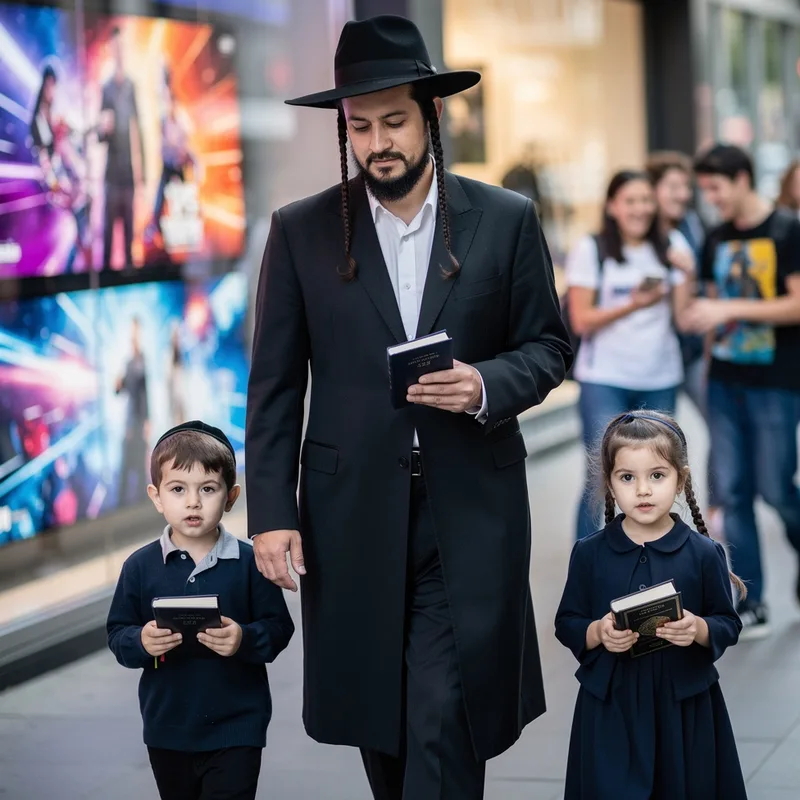
In a Haredi neighborhood, it is common to see people dressed in modest clothing that adheres to strict religious guidelines.
Synonyms
 11
4.2
11
4.2
A person who strictly follows the traditional religious laws of Judaism
 1
9.5
1
9.5
A person in Orthodox Judaism who follows strict religious rules and spiritual traditions


 1
9.9
1
9.9
A member of a Jewish group that follows strict religious rules and values prayer, joy, and close community
How Traditional

Surface Forms
Etymology
Haredi comes from the Hebrew root charad, which means 'to tremble' or 'to fear' before God. That's why Haredi describes very religious people who often keep apart from modern secular life.