
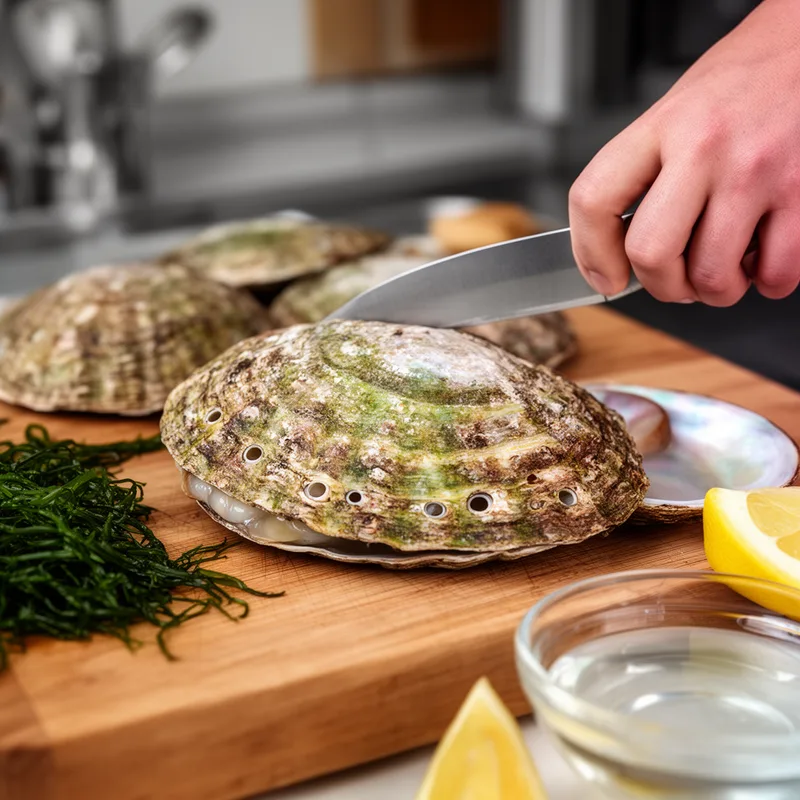
Haliotis tuberculata
- noun
- Specialized
- The European or ormer abalone is scientifically known as Haliotis tuberculata.
Examples
-
Marine biologists have documented the declining population of Haliotis tuberculata around the Channel Islands.
-
The Haliotis tuberculata is often harvested for its edible flesh.
-
Overfishing poses a serious threat to Haliotis tuberculata and other related abalone species.
-
Have you ever tried Haliotis tuberculata at a seafood restaurant?
-
Marine biologists have documented the declining population of Haliotis tuberculata around the Channel Islands, where its flattened shell is often admired.
-
Overfishing poses a serious threat to Haliotis tuberculata, a species prized for its tender and edible flesh.
-
Many seafood lovers consider Haliotis tuberculata, also known as the European abalone, a delicacy in various culinary dishes.
Synonyms

A small edible sea snail with a flat shell eaten as a special food

A sea snail with a flat ear-shaped shell found near the Channel Islands
Surface Forms
Morphology
Haliotis + tuberculata
This is a scientific Latin binomial: the first element 'Haliotis' identifies the abalone genus (transparent), while 'tuberculata' is a Latin adjective meaning 'having tubercles' (not provided in the learner dictionary). Understanding the compound requires taxonomic/Latin knowledge and does not directly convey everyday attributes like edibility or geographic range. Because the name is partially compositional for someone who knows the Latin element but opaque to an average B1 learner, it is best classed as semi-transparent.
Etymology
Haliotis tuberculata comes from older words: Haliotis refers to the 'sea' and an 'ear' because the shell looks like a flat ear, and tuberculata means 'having small bumps' that describe its shell. So the name gives a simple picture of this abalone species with a flat, bumpy shell found near the Channel Islands.

