

Hakea leucoptera
- noun
- Specialized
- The Hakea leucoptera blooms with clusters of creamy white flowers during the summer months.
Examples
-
On our trip through eastern Australia, we saw a dense stand of Hakea leucoptera shrubs in the arid scrubland.
-
In spring, the Hakea leucoptera showcases its creamy white flowers, attracting various pollinators.
-
Many birds are attracted to the spiky branches of Hakea leucoptera for shelter and food.
-
The Hakea leucoptera thrives in dry conditions.
-
Many gardeners love the Hakea leucoptera for its beauty.
-
We spotted a Hakea leucoptera during our hike, its sharp pointed leaves contrasting against the bright blue sky.
-
The Hakea leucoptera is well-known for its resilience, thriving even in Australia's harsh, dry climates.
Synonyms
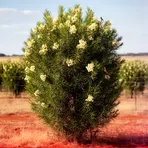
A large bush with sharp pointed leaves and creamy white flowers from central and eastern Australia

A large bush with sharp pointed leaves and creamy white flowers from central and eastern Australia

A large bush with sharp pointed leaves and creamy white flowers
Surface Forms
Morphology
Hakea + leucoptera
This is a scientific binomial (genus + species epithet) and functions as a taxonomic proper name rather than a compositional English phrase; the second element 'leucoptera' is not a common English word and is marked as not found in the dictionary. Understanding that it denotes a particular shrub requires botanical or Latin-root knowledge beyond B1 vocabulary, so the meaning is not transparently derivable from the constituents.
Etymology
Hakea leucoptera may come from the Greek parts leuco ('white') and ptera ('wing'), because the shrub has pale, wing-like parts on its seeds and small white-tinted hairs that look a bit like tiny wings. So the name paints a picture of a 'white-wing' hakea and helps you remember the bush with creamy flowers and whitish seed parts.

