
Haeckel
 1
9.9

- proper noun
- /ˈhɛkəl/
- The intricate illustrations of marine life by Haeckel captivated both scientists and artists alike.
- Ernst Haeckel
- Haeckel's recapitulation
- Haeckel's theory
Examples
-
In his writings, Haeckel advocated for the importance of evolution in understanding biological diversity.
-
Ernst Haeckel was a prominent figure in the study of evolution during the late nineteenth century.
-
Haeckel emphasized the relationships of all animals with their organic and non-organic environments.
Academic text (2018) -
Haeckel emphasized the holism of nature, and his views strongly influenced the development of the science of ecology.
Academic text (1995) -
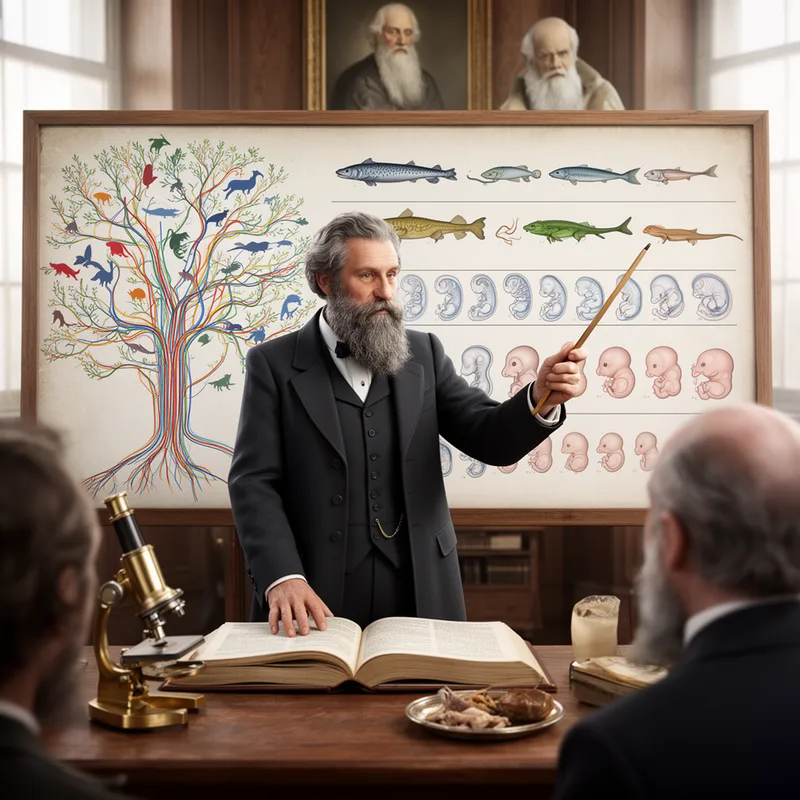
Haeckel formulated the recapitulation theory, in which the ontogenesis of an individual is seen as an accelerated repetition of the phylogenesis.
Academic text (1992) -
The term 'ecology' was coined by the German zoologist Ernst Haeckel in 1866 (Stauffer, 1957).
Academic text (2018) -
In place of the Protoctista, Whittaker (1959) now proposed a purely unicellular kingdom, Protista—an idea that he attributed to Ernst Haeckel.
Academic text (2012)
Surface Forms
Etymology
Haeckel is a German family name, best known as the last name of the scientist Ernst Haeckel. He became famous for detailed biological drawings and for the idea that embryos seem to 'replay' the history of a species, so in science writing Haeckel usually means that biologist and his ideas.