

Gypsophila paniculata
- noun
- /ˌdʒɪp.səˈfaɪ.lə pəˌnɪk.jʊˈleɪ.tə/
- Specialized
- The florist used Gypsophila paniculata in the wedding bouquet.
Examples
-
The florist added sprigs of Gypsophila paniculata to the bouquet for a delicate touch.
-
Dried Gypsophila paniculata can last for months and is popular in wreaths.
-
Many gardeners grow Gypsophila paniculata for its airy clusters of flowers.
-
Many brides choose Gypsophila paniculata for its delicate appearance.
-
The florist arranged a beautiful bouquet featuring Gypsophila paniculata to add texture and elegance.
-
In many weddings, Gypsophila paniculata is popularly used as a delicate filler flower.
-
Gardeners love Gypsophila paniculata for its airy clusters of tiny white flowers that bloom in summer.
Synonyms
 2
6.9
2
6.9

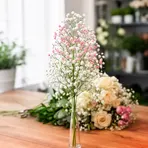
A tall plant with many small white or pink flowers used in flower arrangements

A tall plant with thin stems and many small white or pink flowers used in bouquets
Surface Forms
Morphology
Gypsophila + paniculata
The form is a scientific binomial (genus + species), so a learner who knows the constituents can infer it denotes a particular type or species of Gypsophila. However, the specific epithet is Latin and not a common English word and the precise traits in the definition (tall perennial, many tiny flowers used in arrangements) are not directly predictable from the parts, so the composition is only partially transparent to a B1 learner.
Etymology
Gypsophila paniculata comes from old Greek: gypsophila means 'gypsum-loving' because the plant often grows in chalky ground, and paniculata means 'with many small flower clusters' because its flowers form airy groups. So the name describes a plant that likes chalky soil and has delicate, cloud-like sprigs used in bouquets.