
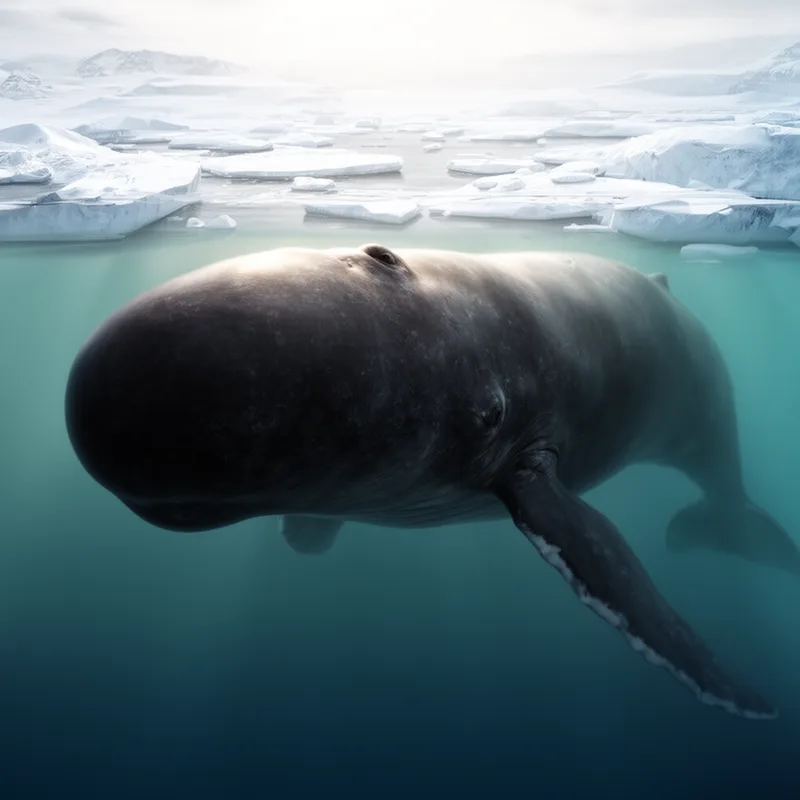
Greenland whale
- noun
- /ˈɡriːn.lænd weɪl/
Examples
-
The vessel Mary D. Hume left San Francisco in April 1890 and returned in September 1892 with 38 Greenland whales worth $400,000.
Academic text (1994) -
Scoresby (1820) found Greenland whale stomachs contained predominantly small crustaceans he called "squillae and shrimps."
Academic text (1995) -
The Greenland whale is known for its massive bow-shaped head, which distinguishes it from other baleen whales.
-
Many researchers study the Greenland whale to understand its feeding habits and migration patterns in the Arctic.
-
The population of the Greenland whale has been closely monitored due to its significance in marine ecosystems.
Synonyms

 1
9.3
1
9.3

A large Arctic whale with a big curved head and thick layer of fat


 1
6.7
1
6.7
A very large whale that lives in Arctic waters with a curved mouth and big body

A very large whale that lives in Arctic waters and filters food with plates in its mouth
Surface Forms
Morphology
The compound simply combines the place name 'Greenland' with 'whale', so a B1 learner who knows both words would readily infer it refers to a whale associated with Greenland/Arctic waters. While the precise taxonomic label 'bowhead whale' is specialized, the basic referent (a large Arctic whale) is transparently derivable from the constituents. Place+animal compounds are cross-linguistically common, supporting immediate comprehension.
Etymology
The name Greenland whale comes from early whalers who saw this huge whale with a big, bow-shaped head near Greenland, so they named the animal for the place and the animal: Greenland + whale. That's why today Greenland whale means the large 'bowhead whale' found in Arctic waters.