
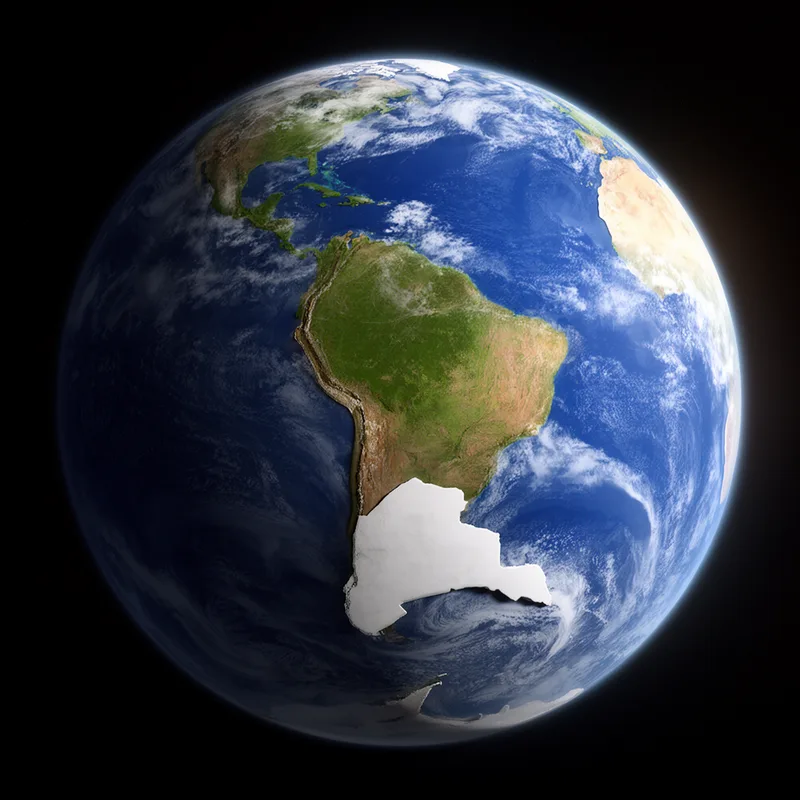
Gondwanaland


 1
9.9
- noun
- /ɡɒndwɑːnəˌlænd/
- Specialized
- Maps of continental locations over geologic time show the closing of the Tethys Sea between Laurasia and Gondwanaland by the northwest movement of Africa and India over the past 225 million years.
Examples
-
Some 150 million years ago, it formed part of the immense southern continent that scientists have named Gondwanaland and was linked to Australia, New Zealand, India, Africa, and South America.
Academic text (1990) -
Most of these fish slowly became extinct as Antarctica sheared away from the rest of Gondwanaland and gradually cooled.
Academic text (1992) -
If you remember your plate tectonics courses, you'll recall that once there was a time when most of the present continents of Earth were joined together in one big continent called Gondwanaland.
Fiction book (1991) -
Gondwanaland was a supercontinent that existed during the late Precambrian and comprised modern continents like Gondwanaland, Africa, and South America.
-
Scientists believe that Gondwanaland began to break apart around 180 million years ago, leading to the separation of continents.
-
The fossil records found on different continents provide evidence that they were once connected in the ancient supercontinent known as Gondwanaland.
Surface Forms
Morphology
Etymology
Gondwanaland comes from Gondwana + land; Gondwana is a region in central India and its name means 'land of the Gonds', a tribal people. That's why the name was used for the huge southern land that long ago included South America, Africa, Antarctica, Australia and the Indian subcontinent.