
Gog and Magog
 1
9.9

- noun
- Literature
- According to the prophecy, Gog and Magog will rise against the faithful.
Examples
-
The story of Gog and Magog appears both in the Book of Ezekiel and the Book of Revelation.
-
In Christian eschatology, Gog and Magog are seen as symbols of ultimate evil opposed to God.
-
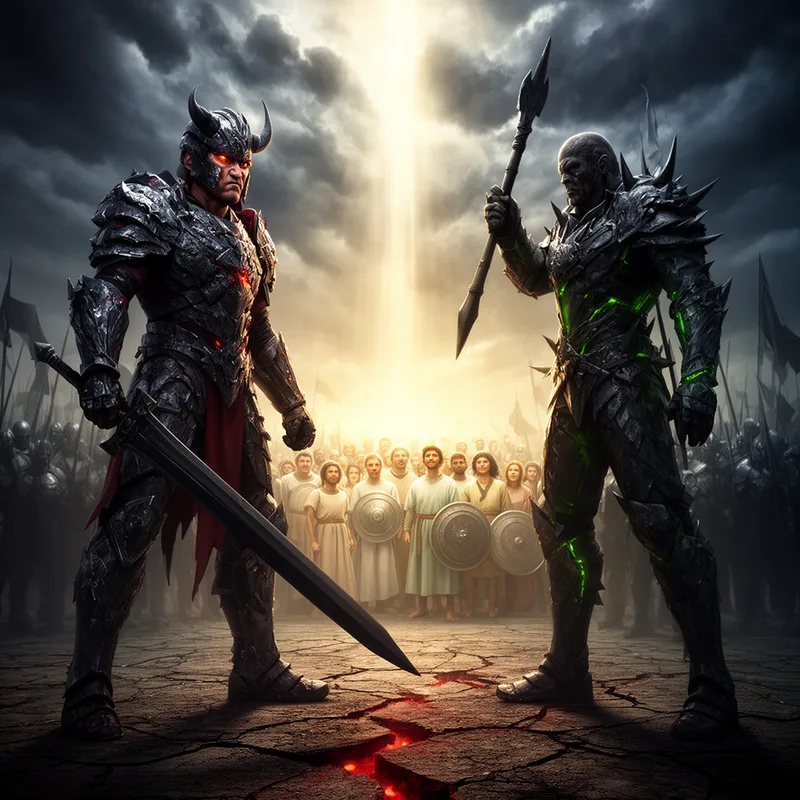
Many paintings depict Gog and Magog in dramatic scenes of battle at the end times.
-
Many are fascinated by Gog and Magog!
-
In the prophecy, Gog and Magog are depicted as the enemies who will rise against God's people in the final battle.
-
The War of Gog and Magog is foretold to occur at the end of the world according to biblical scripture.
-
Many scholars interpret Gog and Magog as representing chaotic forces that will challenge divine authority in apocalyptic literature.
Surface Forms
Morphology
The phrase consists of two proper names whose literal meanings do not combine to yield the specific sense of ‘enemies in end-time prophecy.’ Knowing that 'Gog' and 'Magog' are biblical names does not allow a B1 learner to infer the conventional, culturally specific sense (apocalyptic foes) without prior exposure. This is a fixed, culturally bound reference rather than a compositionally predictable phrase.
Etymology
Gog and Magog come from the Bible as two names for great enemies who join in a final battle against God's people. The strong picture of Gog and Magog fighting at the 'end of the world' makes their names a quick way to mean 'ultimate enemies' or great evil.