
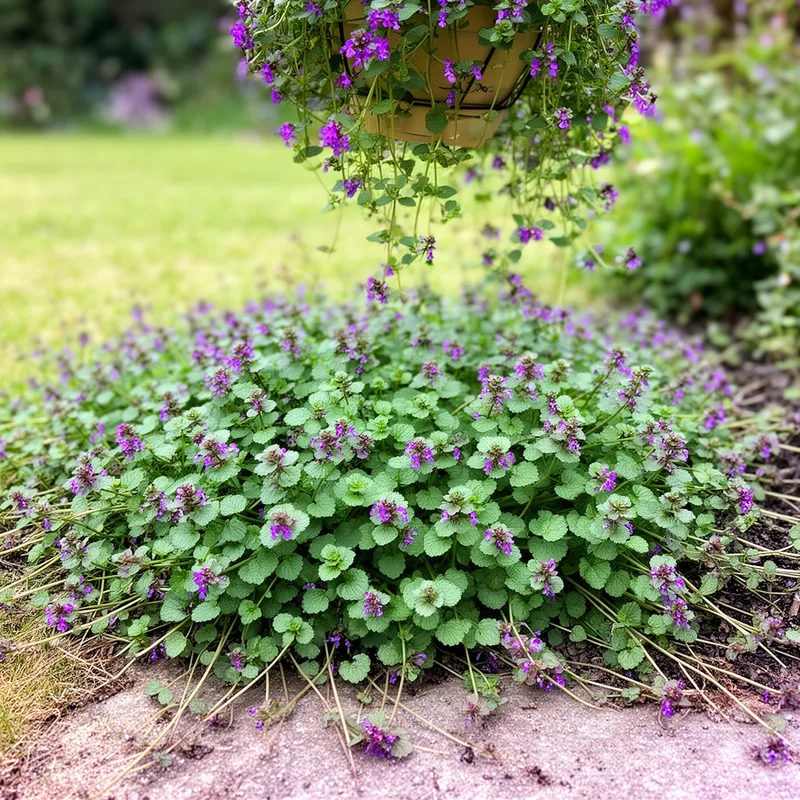
Glechoma hederacea
- noun
- Specialized
- Glechoma hederacea, known for its rounded leaves, is often planted as a ground cover in gardens.
Examples
-
Some gardeners refer to Glechoma hederacea as ground ivy in their landscaping guides.
-
Glechoma hederacea spreads rapidly and can cover large areas in suitable climates.
-
Glechoma hederacea is often used in hanging baskets for its decorative foliage.
-
The Glechoma hederacea thrives in shady areas.
-
I planted Glechoma hederacea in my garden last spring.
-
Glechoma hederacea produces small purplish flowers that attract pollinators in late spring.
-
Glechoma hederacea can be an attractive addition to landscaping due to its trailing growth habit.
Synonyms


 1
9.9
1
9.9
A trailing European plant in the mint family with round leaves and small purple flowers

A low plant like mint that spreads across the ground with round leaves and small purple flowers

A trailing mint plant with rounded leaves and small purple flowers often used in hanging baskets

A small plant often grown in hanging baskets with trailing stems, rounded leaves and small purple flowers

A trailing plant like mint with rounded leaves and small purple flowers often grown in hanging baskets

A low green plant that grows along the ground with round leaves and small purple flowers
Surface Forms
Morphology
Glechoma + hederacea
This is a Latin scientific binomial rather than a normal English compositional phrase; knowing the listed constituents does not let a B1 learner derive the full botanical description (aromatic trailing mint with rounded leaves and purplish flowers). One element ('hederacea') lacks a dictionary definition here and the name encodes specialist taxonomic information, so the overall meaning is not transparently predictable from the parts.
Etymology
Glechoma hederacea may come from an old Greek word for a mint-like herb and the Latin word hedera, which means 'ivy', because the plant spreads and creeps over the ground like a small ivy; that's why people often call it 'ground ivy' today.