
Gigantopithecus


 1
9.9
1
9.9
- proper noun
- /ˌdʒaɪˌɡæn.təˈpɪθ.ɪ.kəs/
- Specialized
- When Pei saw the fossil, he was able to identify it at once as the jawbone of Gigantopithecus because it had all but three of its teeth still attached.
- Gigantopithecus tooth
- Gigantopithecus jawbone
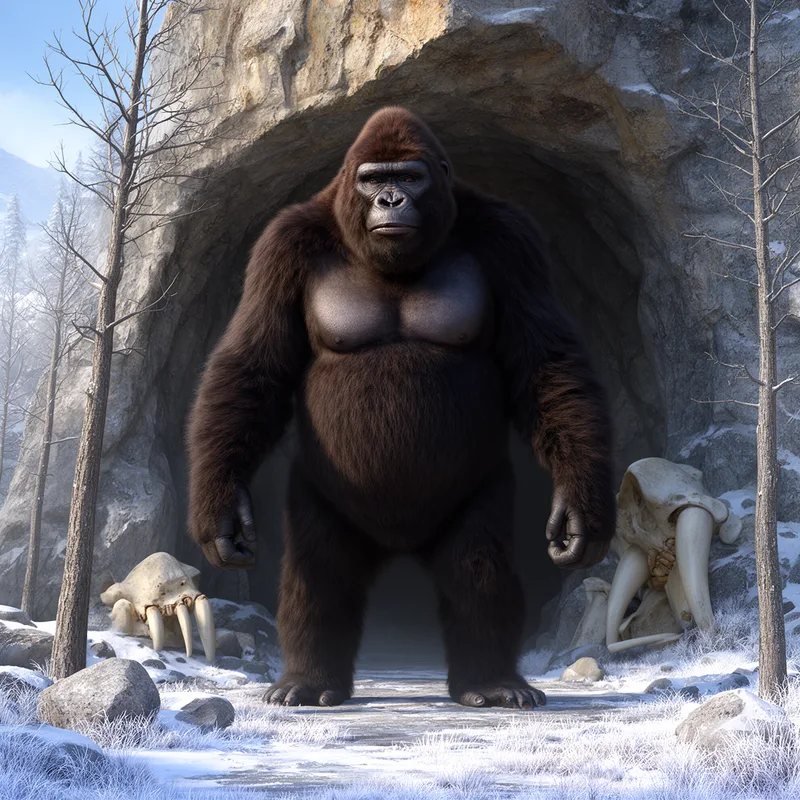
- Gigantopithecus male
Examples
-
The next development came in 1965 with the discovery of twelve Gigantopithecus teeth at Wuming, a few hours' drive north of Nanning.
Academic text (1991) -
Sometime near the end of the middle Pleistocene, perhaps 200,000 years ago, Gigantopithecus became extinct.
Academic text (1991) -
One of them was a Gigantopithecus tooth.
Academic text (1991) -
So far, we have been disappointed only by the absence of Gigantopithecus.
Academic text (1991) -
Similarly, human hunting may have led to the demise of Gigantopithecus.
Academic text (1991) -
On a second visit, in 1957, Pei's team discovered the first Gigantopithecus jawbone in place, in a very hard deposit resembling red clay.
Academic text (1991) -
A further similarity between Gigantopithecus and the giant panda is a high incidence of tooth cavities.
Academic text (1991) -
Photo: A cave near the top of the rounded limestone tower at Liucheng, China, has yielded three Gigantopithecus jawbones and nearly a thousand teeth.
Academic text (1991) -
Australian anatomist Charles Oxnard statistically analyzed 735 teeth of Gigantopithecus that were complete enough to be measured accurately.
Academic text (1991) -
Paleontologists uncovered fossil remains of Gigantopithecus in Asia, providing insights into this ancient species.
Surface Forms
Etymology
Gigantopithecus names a real, now extinct ape and comes from Greek parts gigant meaning 'giant' and pithecus meaning 'ape'. That's why scientists gave the name to a very large ape that lived in Asia long ago.