
Ghanaian
 3
4.5

- adjective
- /ɡəˈneɪ.ən/
- Divine Chocolate is co-owned by a Ghanaian cocoa farmer's cooperative in the town of Kuapa Kokoo.
- Ghanaian economy
- Ghanaian culture
- Ghanaian language
Loading YouTube…
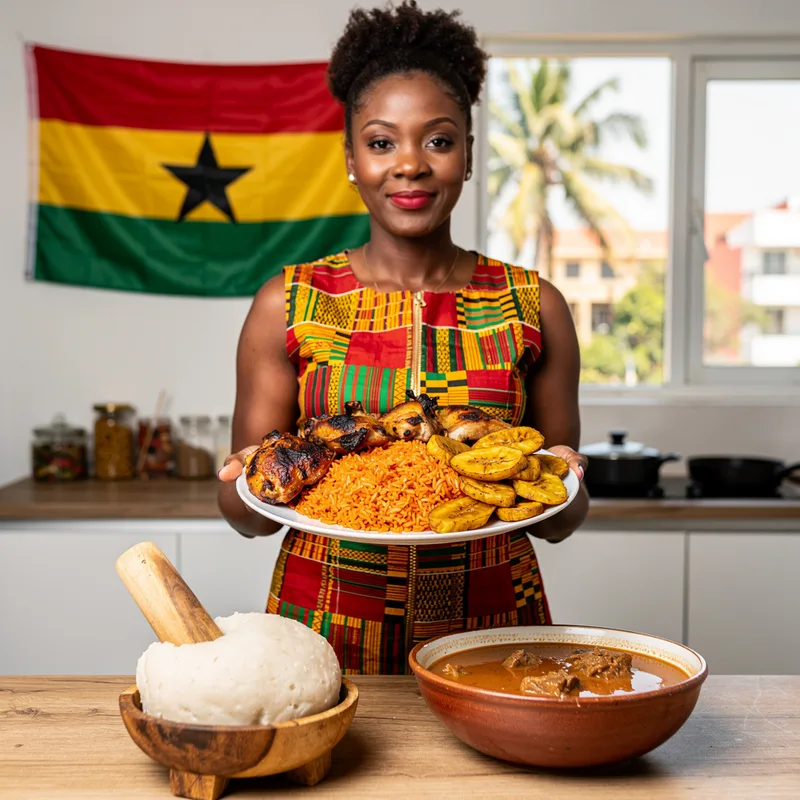
Watch on YouTubeI assume that you love Ghanaian Jellof rice more than Nigerian Jellof rice.
- I assume that you love Ghanaian Jellof rice more than Nigerian Jellof rice.
- You know, like I'm walking around at the moment with this tiny little chain on, but the pendants on it are Junyami, which is a Ghanaian symbol, which means trust in God.
- There are certain Ghanaian things and you don't deviate from those.
Examples
-
He learned to speak Ghanaian English, which has a distinct accent and vocabulary.
-
Manufacturing and construction, both in deep recession in 1980-83, are areas where Ghanaian capital is of some importance.
Academic text (1991) -
The governor she appointed for the Gold Coast did not understand any Ghanaian language either.
Academic text (1995) -
After this, primary and junior secondary education are to be compulsory for all Ghanaian children of school age.
Academic text (2000) -
Important issues like the problems with the Ghanaian voters' register were never addressed.
Academic text (1992) -
Thus, local musicians have remained the most reliable teachers of indigenous Ghanaian music.
Academic text (2000) -
Ama Ata Aido is a prominent Ghanaian writer, playwright, and poet.
Fiction book (1993) -
The Ghanaian culture is rich in traditions and vibrant festivals that attract many visitors.
-
Many Ghanaian dishes are known for their unique flavors and use of locally sourced ingredients.
Surface Forms
Morphology
Etymology
Ghanaian comes from the country name Ghana and the ending -ian, which you also see in Canadian and Brazilian. The name Ghana was chosen to connect the modern country to an old West African kingdom called Ghana, so Ghanaian means 'of or from Ghana'.