
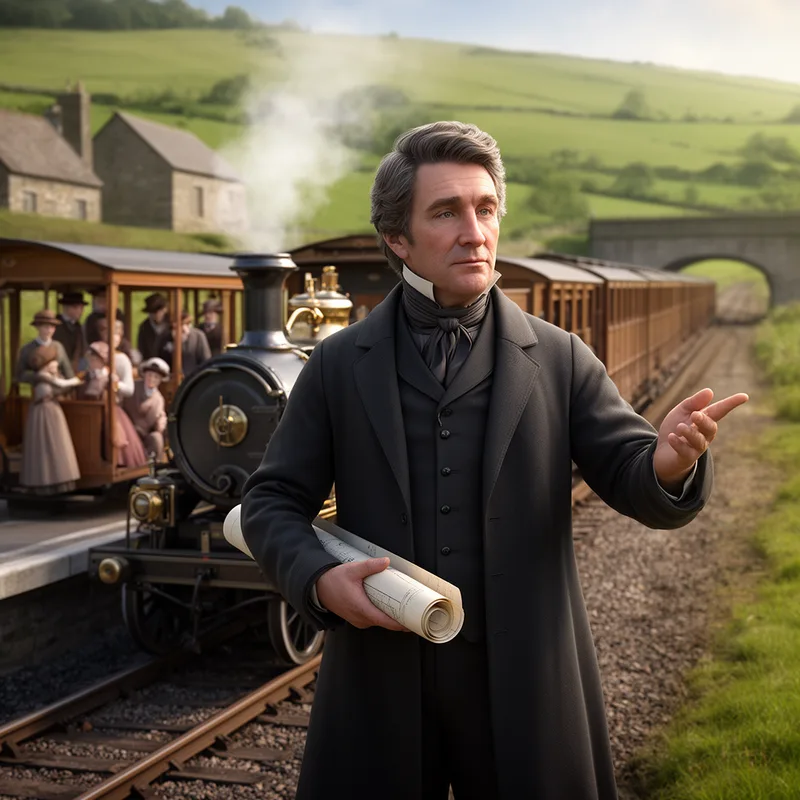
George Stephenson


 1
6.0
- proper noun
- In 1825, George Stephenson launched the Stockton and Darlington Railway, marking a key moment in railway history.
Examples
-
George Stephenson is often called the 'Father of Railways' for his pioneering work.
-
The Stockton and Darlington Railway, engineered by George Stephenson, opened in 1825.
-
Many history books credit George Stephenson with revolutionizing transport during the Industrial Revolution.
-
The innovations of George Stephenson changed transportation forever.
-
Did George Stephenson really build the first steam locomotive?
-
George Stephenson is known as the 'Father of Railways' because he built the first public railway in 1825.
-
Many consider George Stephenson to be a key pioneer in railway engineering due to his innovative designs.
Surface Forms
Morphology
George + Stephenson
This is a proper name referring to a specific historical person; the meaning (an English engineer and railway pioneer) is not compositionally built from the parts 'George' and 'Stephenson'. Knowing the constituent names does not let a B1 learner infer the biographical or occupational information, and personal names are arbitrary across languages, making the expression non-compositional for learners.
Etymology
George Stephenson was an English engineer who built the first public steam railway for passengers in 1825 and made a famous locomotive called the 'Rocket'. His success made trains practical, so people often call him the 'Father of Railways'.