
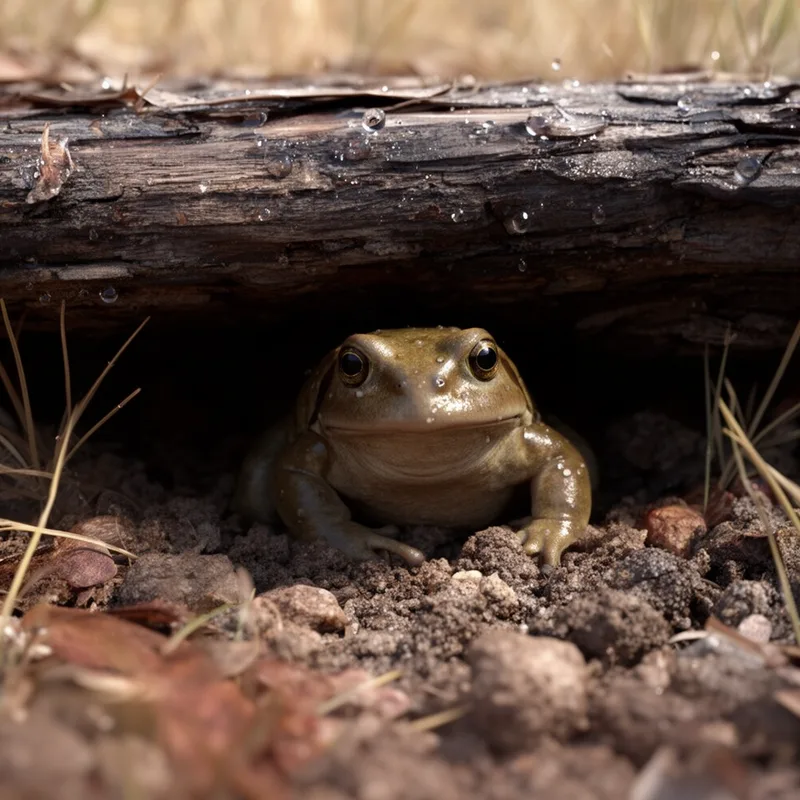
Gastrophryne olivacea
- noun
- Specialized
- The Gastrophryne olivacea spends most of its life hidden beneath logs or in loose soil.
Examples
-
Biologists observed several Gastrophryne olivacea near the western edge of Texas after a rainfall.
-
Because of its secretive habits, the Gastrophryne olivacea is rarely seen by casual hikers.
-
The Gastrophryne olivacea is often found near wetlands.
-
Have you seen a Gastrophryne olivacea before?
-
Due to its smooth, tough skin, the Gastrophryne olivacea can remain hidden from predators in its natural habitat.
-
Researchers noted that the Gastrophryne olivacea is primarily active at night, making it difficult to spot during the day.
-
In the spring, the Gastrophryne olivacea emerges to breed in shallow pools, showcasing its unique adaptations.
Synonyms

A small toad with smooth tough skin that hides and lives in central and western North America
Surface Forms
Morphology
Gastrophryne + olivacea
This is a Latin binomial (a taxonomic proper name) rather than a compositional English phrase; the parts are specialist/Latin morphemes (the second element is not even in the dictionary here), so a B1 learner who ‘‘knows the words’’ would not be able to derive the meaning 'a particular toad species' from them. Scientific names are referential and language-specific rather than transparently built from everyday English vocabulary, making the overall meaning unpredictable for typical learners.
Etymology
Gastrophryne olivacea may come from ancient Greek and Latin words. Gastrophryne joins gastro- ('stomach') and -phryne ('toad') because the species has a round belly, and olivacea means 'olive-colored', so the name paints a simple picture of a small, olive-brown, belly-shaped toad and helps you remember this secretive animal.

