
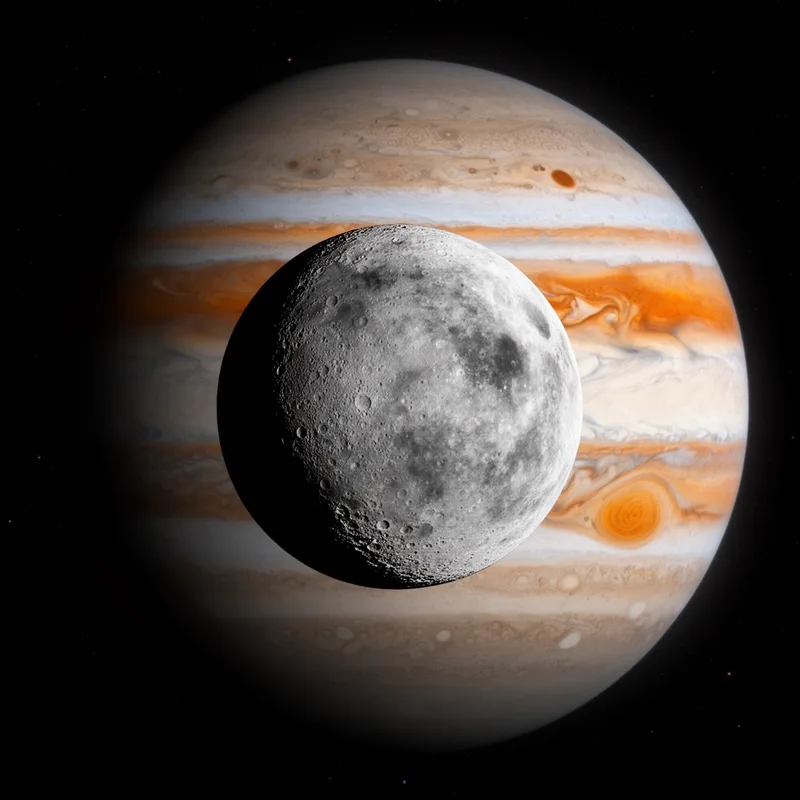
Ganymede
 9
8.4
9
8.4

- proper noun
- /ˈɡænɪˌmiːd/
- First of all, Ganymede is the largest moon of Jupiter.
- Ganymede (Jupiter)
- Ganymede and Callisto
- Ganymede moon
Examples
-
So IO, Europa, Ganymede and Callisto should come in next.
-
Mercury is also smaller than Ganymede (Jupiter's largest moon).
Academic text (2003) -
Three of these moons are larger than our Moon, and Ganymede is even bigger than Mercury.
Academic text (2002) -
As you rightly point out, Ganymede has the qualitative distinction of not orbiting the Sun directly.
Blog text (30) -
The Galileo spacecraft's recent discovery of a magnetic field around Ganymede reinforces the potential, on other massive moons, for a biosphere similar to our own.
Academic text (1999) -
Mission to the icy moons: A vision for the future of space exploration includes a spacecraft orbiting Jupiter's third Galilean satellite, Ganymede.
Academic text (2004) -
In 1609-1610, Galileo had used his new telescope to discover four moons circling Jupiter (later named Io, Europa, Ganymede, and Callisto).
Academic text (2002) -
Io's disk appears grayish on Jupiter's cloudtops, while Europa is very light and often difficult to recognize, especially when it lies in front of a bright band in Jupiter's atmosphere. Ganymede and Callisto appear somewhat darker, so they are usually easy to see.
Academic text (2002) -
First of all, Ganymede is the largest moon of Jupiter.
-
Three of these moons are larger than our Moon, and Ganymede is even bigger than Mercury.
How Big

Surface Forms
Etymology
Ganymede (the moon) was named after that Greek youth who became the gods' 'cupbearer' when Zeus took him to Olympus, so the largest moon of Jupiter carries his name as a link to the story.