
Galton
 1
9.6

- proper noun
- /ˈɡɔltən/
- In his studies, Galton emphasized the importance of heredity in influencing human traits and abilities.
- Francis Galton
- Sir Francis Galton
- Galton's eugenics
Loading YouTube…
Watch on YouTubeWell, Francis Galton, who is a cousin of Charles Darwin, went to a County Fair in England.
- Well, Francis Galton, who is a cousin of Charles Darwin, went to a County Fair in England.
Examples
-
Francis Galton, a prominent scientist in the nineteenth century, made significant contributions to statistics and anthropology.
-
Social philosopher Sir Francis Galton, cousin of Charles Darwin, coined "eugenics" in 1883, the year Friedrich Nietzsche published Also Spake Zarathustra.
Academic text (2014) -
With respect to her contributions to the field, her importance might well equal that of Galton and Terman.
Academic text (1990) -
Well, Francis Galton, who is a cousin of Charles Darwin, went to a County Fair in England.
-
According to Galton, eminence is the inevitable destiny of any man with extraordinary ability who is willing to work.
Academic text (1995) -
When, as a field, we look to our antecedents, two names usually receive first mention: Francis Galton and Lewis Terman.
Academic text (1990) -
Galton's central emphasis on the hereditary forces in the emergence of genius is well-known.
Academic text (1996) -
By 1914, Galton's eugenics curricula spread to forty-four universities, including Harvard, Columbia, Cornell, and Brown.
Academic text (2014) -
Among his distinguished successors in this period, we can identify T. H. Huxley, Leslie Stephen, Francis Galton, William James, John Dewey, and Thorstein Veblen.
Academic text (2002) -
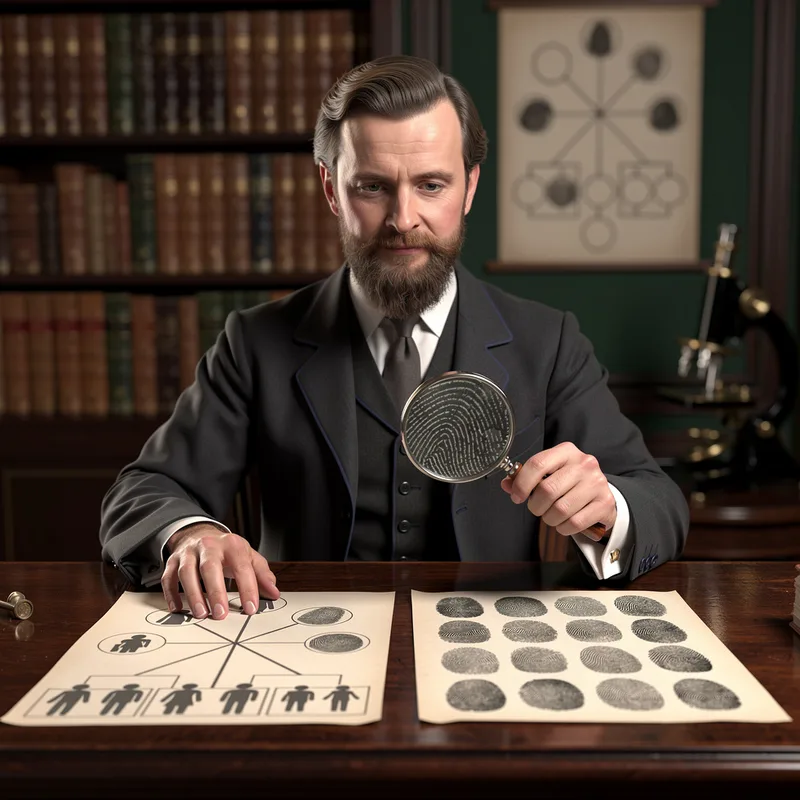
Sir Francis Galton was a pioneer in the field of eugenics and introduced the use of fingerprints for identification.
Surface Forms
Etymology
Galton is the family name of Francis Galton, an English scientist who studied heredity, helped start modern statistics, and introduced fingerprints for identification, though he also promoted the controversial idea of eugenics. So, when you see Galton, it usually refers to that scientist or his ideas about heredity and statistics.