
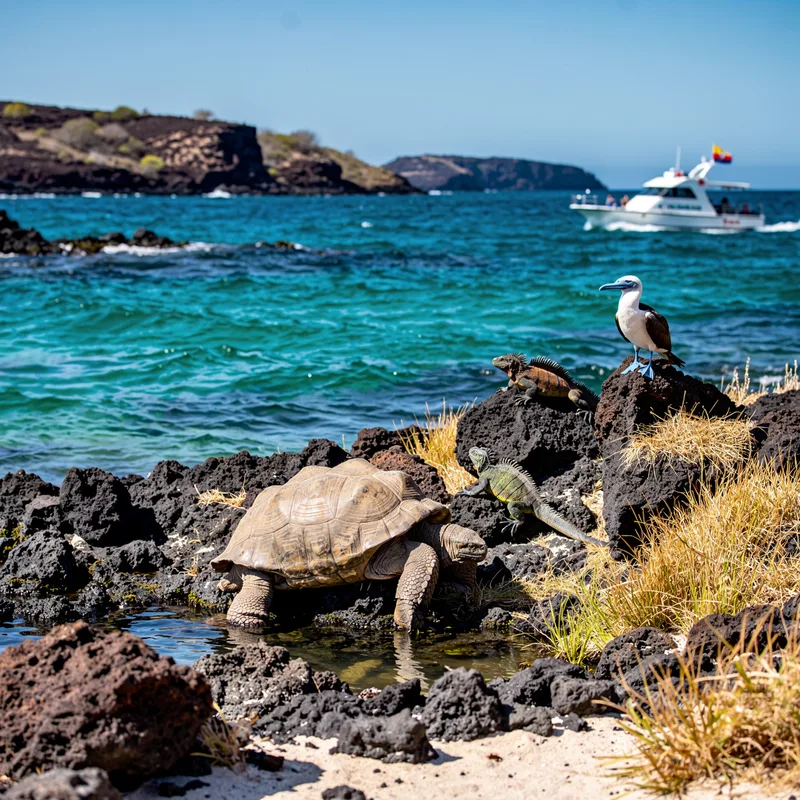
Galapagos Islands
 6
3.2

- proper noun
- /ɡəˈlæpəɡoʊs ˈaɪləndz/
- Many tourists travel to the Galapagos Islands to experience its unique wildlife and natural beauty.
- Ecuador's Galapagos Islands
- visit the Galapagos Islands
- Darwin's Galapagos Islands
Examples
-
Researchers study the biodiversity of the Galapagos Islands to better understand evolution.
-
I'm gonna go to the Galapagos Islands.
-
We went to the Galapagos Islands to see the penguins.
Fiction book (2002) -
Finches on the Galapagos Islands are an excellent example.
Blog text (14) -
When you come out to the Galapagos Islands, you're very prepared for appreciating what you find there.
-
We went on a tour of the Galapagos Islands developed by Maria Coffey and Dag Goering of Hidden Places, and this time led by Maria.
Blog text (25) -
She's always wanted to visit the Galapagos Islands—her statement to the press—a place of origins, a place of beauty, a place of scientific discovery, a place like no other place in the world.
Fiction book (1996) -
A friend and I were fortunate enough to travel to the Galapagos Islands last year with Maria Coffey, who owns Hidden Places Travel (a boutique adventure travel company based in Vancouver) with her husband, Dag Goering.
Blog text (25) -
The Galapagos Islands are known for their giant tortoises and diverse marine life.
Synonyms
 20
4.2
A group of islands in the Pacific Ocean off Ecuador known for unique animals
Surface Forms
Morphology
The phrase is fully compositional: 'Galapagos' is a place name referring to that archipelago and 'islands' denotes the geographic feature, so together they denote the group of islands called the Galapagos. This follows a common place-name + feature pattern cross-linguistically, so a B1 learner who knows both constituents will comprehend the meaning.
Etymology
Galapagos Islands comes from an old Spanish word galápago that meant a 'saddle' or a 'tortoise'. Early sailors saw giant tortoises with shell shapes like saddles and named the islands after them, so the name now reminds us of the islands' famous animals.