
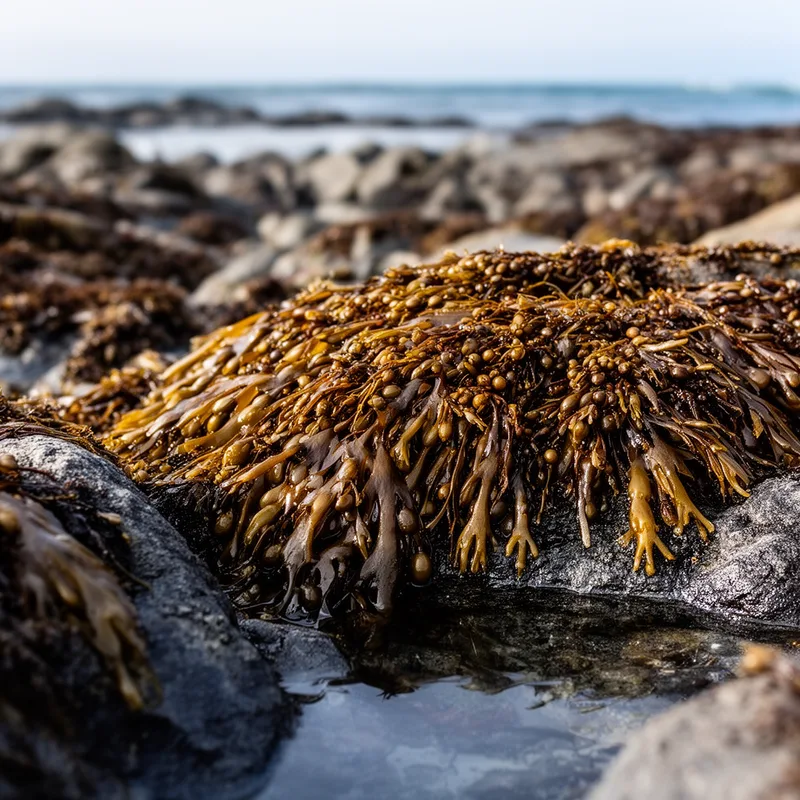
Fucaceae
- noun
- /fuˈkeɪʃiˌi/
- Specialized
- The Fucaceae are abundant along rocky shorelines where they form dense algae beds.
Examples
-
The Fucaceae family includes various species of seaweed.
-
Many marine organisms rely on Fucaceae for habitat.
-
Marine biologists often study the reproductive cycles of the Fucaceae.
-
Several genera within the Fucaceae are important components of intertidal ecosystems.
-
Marine biologists often study the reproductive cycles of the Fucaceae.
-
Several genera within the Fucaceae are important components of intertidal ecosystems.
-
Many marine organisms rely on Fucaceae for habitat.
Synonyms

Brown seaweed that grows on rocky shores at low tide
Brown seaweed that grows on rocks along the coast

A group of brown seaweeds that live mainly in the sea
Surface Forms
Morphology
Fucaceae = Fucus (opaque) = Fuc + aceae
The family-forming suffix '-aceae' is a specialized Latin taxonomic ending and is not a productive, transparent English derivation for general learners.
Etymology
Fucaceae comes from the name Fucus, an old Latin word for 'seaweed', plus the plant-family ending -aceae. So, Fucaceae is the name for a family of seaweeds, like the brown rockweeds found on rocky shores.

