

Fritillaria lanceolata
- noun
- Specialized
- Many gardeners admire Fritillaria lanceolata for its striking green-and-purple, bell-shaped flowers.
Examples
-
The rare Fritillaria lanceolata blooms in spring throughout the woodlands of Oregon and Washington.
-
Botanists were excited to find a cluster of Fritillaria lanceolata along the hiking trail.
-
The Fritillaria lanceolata blooms beautifully in spring.
-
Can you identify the Fritillaria lanceolata in this garden?
-
Many gardeners admire Fritillaria lanceolata for its striking green-and-purple, bell-shaped flowers.
-
The rare Fritillaria lanceolata blooms in spring throughout the woodlands of Oregon and Washington.
-
Botanists were excited to find a cluster of Fritillaria lanceolata along the hiking trail.
Synonyms

A wild plant from northwestern North America with green and purple bell-shaped flowers
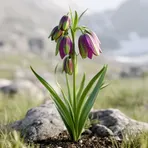
A small wild plant with green and purple bell-shaped flowers

A small plant from northwestern North America with green and purple bell-shaped flowers
Surface Forms
Morphology
Fritillaria + lanceolata
This is a scientific Latin binomial used as a proper name for a species; an average B1 learner would not be able to derive the descriptive meaning from the parts. The genus name 'Fritillaria' signals a group of flowering plants but the epithet 'lanceolata' is not an English lexical item (and no dictionary sense is provided), so the compound functions as an arbitrary label rather than a compositional phrase. Because the meaning is effectively lexicalized and language-specific, it is not transparently interpretable by learners.
Etymology
Fritillaria lanceolata comes from Latin words that describe how the plant looks. The first word Fritillaria may come from 'fritillus' meaning 'dice box' because many species have a checkered, bell-shaped flower, and the second word lanceolata means 'spear-shaped' for its long narrow leaves, so the name helps you picture a checkered bell flower with lance-like leaves.

