

French ultramarine
- noun
- /frɛntʃ ˌʌltrəˈmɛrɪn/
- Specialized
- Many artists prefer French ultramarine for its vibrant hue and consistent texture.
- French ultramarine blue
Examples
-
The artist used French ultramarine in her latest painting.
-
The formula for making French ultramarine was a major breakthrough in 19th-century chemistry.
-
She mixed French ultramarine with other pigments to achieve the desired shade of blue.
-
Have you ever tried French ultramarine for your artwork?
-
In my painting class, I learned to mix French ultramarine with white to create a stunning sky blue.
-
The artist preferred using French ultramarine in her landscapes for its vividness and depth.
-
For the ocean scene, I chose French ultramarine along with other colors for a vibrant effect.
Synonyms

 1
6.8
1
6.8

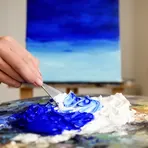
A deep bright blue paint color first made from a stone called lapis lazuli and now often made artificially
 1
7.6
1
7.6
A bright deep blue color used in paint

An intense blue pigment made by people for use in painting
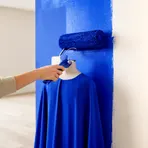
A bright deep blue colour used for paint and cloth

A deep blue pigment made from a blue stone for painting
How Blue

Surface Forms
Morphology
This is a straightforward adjective + noun composition: 'French' specifies the origin or variety of 'ultramarine', so a learner who knows both words will infer it denotes a type/variant of the ultramarine pigment associated with France or French manufacture. The meaning follows a common cross-linguistic pattern of origin/variant modification and is directly derivable from the constituents.
Etymology
French ultramarine is a bright blue pigment made in France to copy the precious natural blue called ultramarine, whose name literally means 'beyond the sea' because ultra meant 'beyond' and marine meant 'sea'. One popular story says French scientists learned to make the same deep blue in a lab so artists could use the color more cheaply, and today the name shows that this made-in-France pigment matches the famous imported blue.