
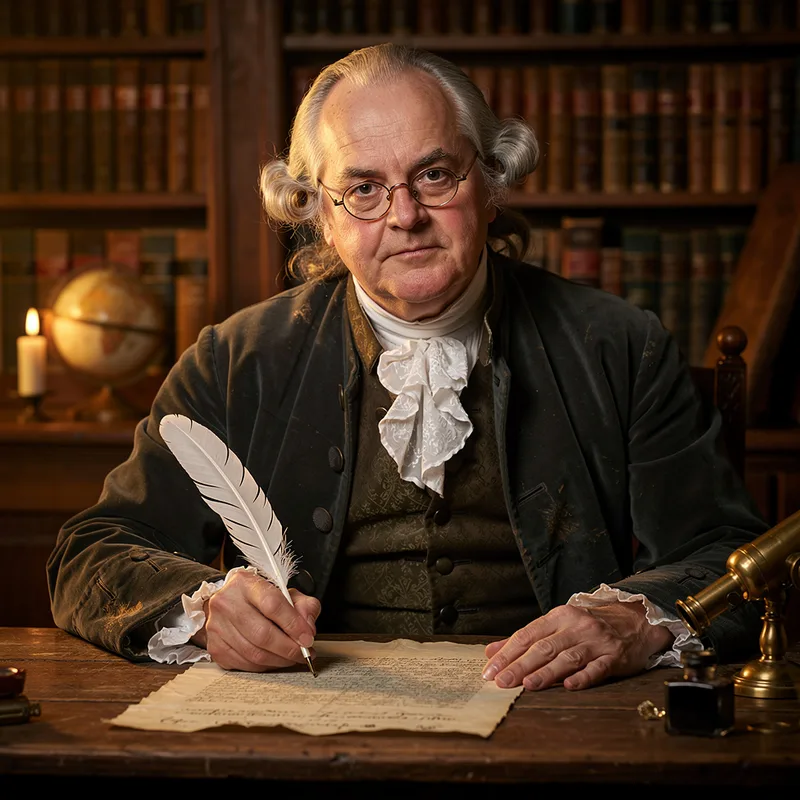
Franklin
 67
4.6

- proper noun
- /ˈfræŋklɪn/
- If you read Franklin's autobiography, you will gain insight into his life and ideas during the founding of the United States.
- Benjamin Franklin
- Franklin and Washington
- Franklin and Jefferson
Loading YouTube…
Watch on YouTubeSo you're a rowing coach and you won the Benjamin Franklin Award for your writing.
- So you're a rowing coach and you won the Benjamin Franklin Award for your writing.
- Benjamin Franklin I was reading about Franklin's autobiography in the last couple of months.
- You know, Ben Franklin had an expression, he was a smart guy.
- Deborah marries another fella, OK, she met Ben Franklin, he proposed.
- Would you rather speak to Rosalind Franklin or Franklin or Albert Einstein?
- So, you know, Benjamin Franklin isn't in summer school.
Examples
-
You know, Benjamin Franklin had to go over to France.
-
You know, Ben Franklin had an expression, he was a smart guy.
-
Its members included Benjamin Franklin, then U.S.
-
For instance, Benjamin Franklin and his son William ended up on opposite sides of the American Revolution.
Academic text (2008) -
After years of conflict between President Franklin D. Roosevelt and Congress, the bill finally became law in 1938.
Academic text (2017) -
In 1933, facing a deep economic crisis, Franklin Roosevelt began a far-reaching reform of domestic agencies.
Academic text (1992) -
The American Embassy paid their respects to Ben Franklin's statue in the courtyard.
Fiction book (1994) -
Time is money, so went Benjamin Franklin's maxim for the modern tradesman.
Academic text (1992) -
There was a glimmer of hope in 1933, when President Franklin Delano Roosevelt created the Civilian Conservation Corps.
Academic text (2011) -
Franklin was a key figure in the American Revolution, known for his contributions to both science and government.
Synonyms
 30
3.4
An American leader, inventor, and writer who helped start the United States and studied electricity
Compounds


 1
3.6
A bridge held up by cables across the Delaware River between Philadelphia and Camden, New Jersey
Surface Forms
Etymology
Franklin comes from an old English word for a 'free' landowner. It joins frank meaning 'free' with the ending -lin, so a franklin was a free person who owned land rather than a noble. That meaning became a family name, which is why the American statesman is known as Franklin.