

Frankenstein's monster
 1
7.8
1
7.8

- noun
- /ˈfræŋkənˌstaɪnz ˈmɑnstər/
- Literature
- Frankenstein's monster had fled, in the end, into the Arctic, there to seek release in a solitary death.
- dressed as Frankenstein's monster
Examples
-
It'd be just as unwelcome and unstable a creation as Dr. Frankenstein's monster.
Academic text (2009) -
Frankenstein's monster survived the mob attack of the original film and is finding his way back to his maker.
Blog text (21) -
Personally, I'm glad we didn't find Frankenstein's monster.
Fiction book (2002) -
Although the Standard Model still holds sway, with the addition of dark matter, dark energy, and now dark flow, it is looking less like an elegant theory and more like Frankenstein's monster!
Blog text (5) -
In the suit and thick-soled boots, he reminded Jamie of Frankenstein's monster waiting impatiently for a bus.
Fiction book (1999) -
Like Dr. Frankenstein's monster, present-day Iraqi Kurdistan has been exposed as an amalgam of parts incompatible not only with each other but with the region as a whole.
Blog text (5) -
In the story, Frankenstein's monster seeks acceptance and understanding from society.
-
During Halloween, many people dress up as Frankenstein's monster in tribute to the classic tale.
-
In most adaptations, Frankenstein's monster is portrayed as a tragic figure searching for companionship.
Synonyms
 470
3.3
470
3.3
A very cruel person who hurts others without pity


 1
8.2
1
8.2
A creation that escapes its maker and causes harm
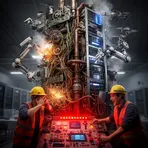
A machine or system made from mismatched parts that becomes dangerous and hard to control
Surface Forms
Morphology
Frankenstein's + monster
This is a straightforward possessive noun phrase: 'Frankenstein's' (the named person) + 'monster' (creature) yields 'the monster belonging to/created by Frankenstein', so a learner who knows possessive constructions and the word 'monster' can infer the basic meaning. Specific literary background (Victor Frankenstein, Shelley's novel) is additional cultural knowledge but not required to derive the compositional meaning, making the expression transparent.
Etymology
Frankenstein's monster comes from Mary Shelley's novel, where scientist Frankenstein creates a large, lonely monster from parts of dead bodies. Today the name means that created creature, and many people even call the creature 'Frankenstein', mixing the maker and the made.