

Francisco José de Goya
- proper noun
- Many critics consider Francisco José de Goya a master of both portraiture and social commentary.
Examples
-
At the museum, we viewed several paintings by Francisco José de Goya.
-
The works of Francisco José de Goya continue to influence modern art.
-
The works of Francisco José de Goya are displayed in many museums.
-
Many art historians study Francisco José de Goya for his unique style.
-
At the museum, we viewed several paintings by Francisco José de Goya.
-
Many critics consider Francisco José de Goya a master of both portraiture and social commentary.
-
The works of Francisco José de Goya continue to influence modern art.
Synonyms
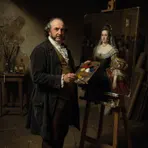
 9
6.7

A Spanish painter known for portraits and works that criticize society
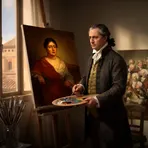 1
5.2
A Spanish painter known for emotional portraits and satirical paintings
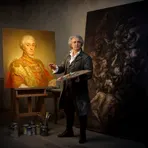

 1
9.8
Spanish painter known for portraits and dark satirical paintings
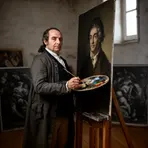
A Spanish painter from 1746 to 1828 known for strong portraits and dark, modern images
Surface Forms
Morphology
Francisco + José + de + Goya
This is a personal name composed of given names and a surname/particle; knowing the individual words (or that 'de' is a name particle) does not let a B1 learner infer the referent's identity or that he was a Spanish painter. Proper names are arbitrary labels whose referential/biographical meaning is not derivable from their parts, so the expression is opaque.
Etymology
Francisco José de Goya was a Spanish 'painter' who made elegant portraits of kings and also powerful, dark images that showed the horrors of war and human weakness. So, his name reminds us of both great portrait skill and sharp 'satire' about society.