
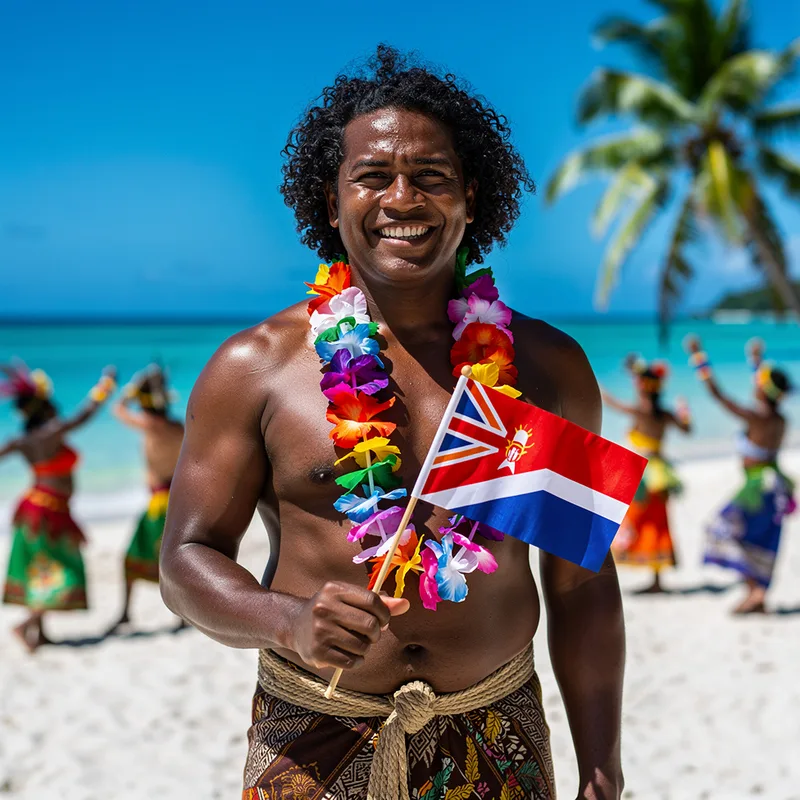
Fijian
 1
3.7

- noun
- /fiˈdʒiən/
- Because the painting suggests parallels in ritual practice, it can be read as a visual confirmation of Fijians' claims to continuity between the practices of the pre-Christian past of their ancestors and their own Christian present.
- Fijians' claims
Examples
-
Indigenous Fijians had statistically significantly higher cervical cancer incidence and mortality rates than Indians (the second largest population group in Fiji).
Academic text (2016) -
"Israelis?" I asked the Fijians nervously.
Academic text (2010) -
The Fijians found an ancient civilization here.
-
We Fijians are, what you might say, superstitious.
-
Of the various items that Fijians exchange in the context of ritual, yaqana is the most essential.
Academic text (1992) -
In the twentieth century, Indians were brought to the island nation of Fiji to work as merchants and civil servants, and within a few decades, the Indians had taken majority control of the island away from the Fijians.
Blog text (19) -
Another study reported similarly that indigenous Fijians had a 1.4-fold relative risk of developing cervical cancer compared with Indian Fijians aged 20-69 years.
Academic text (2016) -
Given the central role that it played in the establishment of legitimacy in traditional polities, it is understandable that yaqona would be employed in the attempt to legitimate ties between Fijians and the colonial government.
Academic text (1992) -
Similarly, Fijians have not ceased to believe in the powers of their human ancestors and ancestral deities but, rather, see these beings as subordinate to the Christian God, Na Kalou.
Academic text (1992) -
Many Fijians enjoy traditional dance during cultural festivals.
Compounds



Surface Forms
Morphology
Etymology
Fijian comes from the name of the islands Fiji, which is from the local name Viti. So a Fijian is simply a person who comes 'from Fiji' or who lives there.