
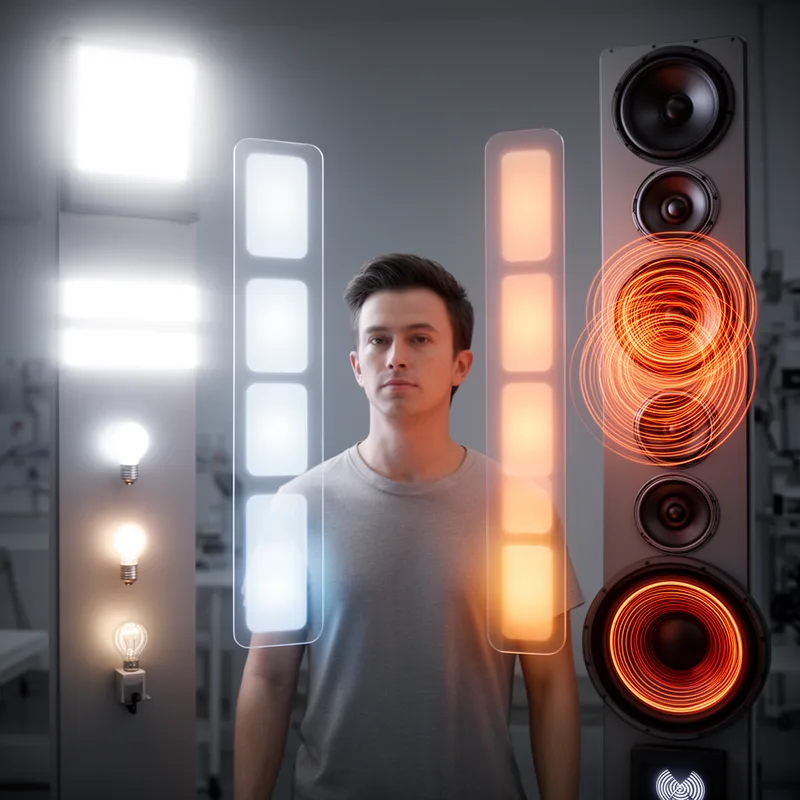
Fechner's law
- noun
- /ˈfɛknərz lɔ/
- Specialized
- According to Fechner's law, a small increase in stimulus intensity can lead to a noticeable change in perception.
Examples
-
Fechner's law explains that as the intensity of a stimulus increases, our perception of that stimulus grows logarithmically.
-
Modern psychophysical experiments still reference Fechner's law when analyzing sensory thresholds.
-
Fechner's law is fundamental to understanding how humans perceive differences in brightness and sound.
-
According to Fechner's law, each equal step in sensation corresponds to a multiplicative increase in stimulus.
-
The concept of Fechner's law is crucial in psychology and sensory studies.
-
Many researchers rely on Fechner's law to study how we detect slight differences in sensory input.
-
In experiments, Fechner's law shows that increased stimulus intensity results in a greater subjective sensation.
Synonyms

A rule saying people notice changes in light or sound by how much they change compared to before
Surface Forms
Morphology
Fechner's + law
This is an eponymic scientific term: 'Fechner's' is a proper name that carries no semantic information about the content, and 'law' only indicates a general principle. A B1 learner who knows 'law' but not Fechner or psychophysics cannot infer the specific logarithmic relation between stimulus intensity and sensation, so the meaning is not derivable from the constituents.
Etymology
Fechner's law is named after the scientist Gustav Fechner, who noticed that our sense of something grows much more slowly than the physical change. Imagine turning up a dim lamp: to feel each equal step of brightness you must make the light much stronger each time, so the rule explains why 'sensation' increases slowly compared to the 'stimulus'.

