
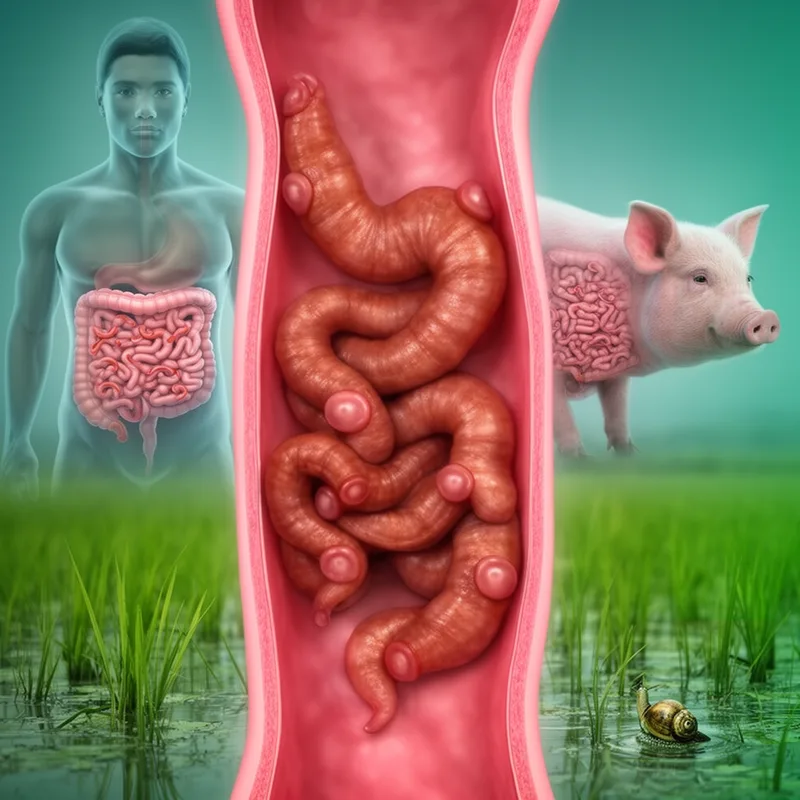
Fasciolopsis buski
- noun
- /fæˌsiəˈlɑp.sɪs ˈbʌs.ki/
- Specialized
- Infection with Fasciolopsis buski can cause severe inflammation of the intestines.
Examples
-
The life cycle of Fasciolopsis buski involves both aquatic snails and pigs as intermediate hosts.
-
Farmers in certain regions are at risk of contracting Fasciolopsis buski from contaminated water plants.
-
The parasite Fasciolopsis buski is known to cause gastrointestinal issues.
-
Infections from Fasciolopsis buski can lead to malnutrition.
-
Farmers in certain regions are at risk of contracting Fasciolopsis buski from contaminated water plants.
-
Infection with Fasciolopsis buski can cause severe inflammation of the intestines.
-
The parasite Fasciolopsis buski is known to cause gastrointestinal issues.
Synonyms

 3
9.9

A small flat worm that lives inside animals and sometimes makes them sick
Surface Forms
Morphology
Fasciolopsis + buski
This is a Latin scientific binomial (a taxonomic proper name), so its meaning as a specific parasitic fluke is not compositionally derived from ordinary English words. The second element 'buski' has no dictionary meaning in English and knowing 'Fasciolopsis' as a genus is specialist knowledge beyond B1, so a B1 learner who knows the constituents would not be able to infer the MWE's parasitic meaning.
Etymology
Fasciolopsis buski comes from two parts: Fasciolopsis means 'looks like a small flat fluke' because of the animal's long, flat shape, and buski honors a scientist named Busk. So the name helps remember it is a flat 'worm' that lives in the intestines of people and pigs.