
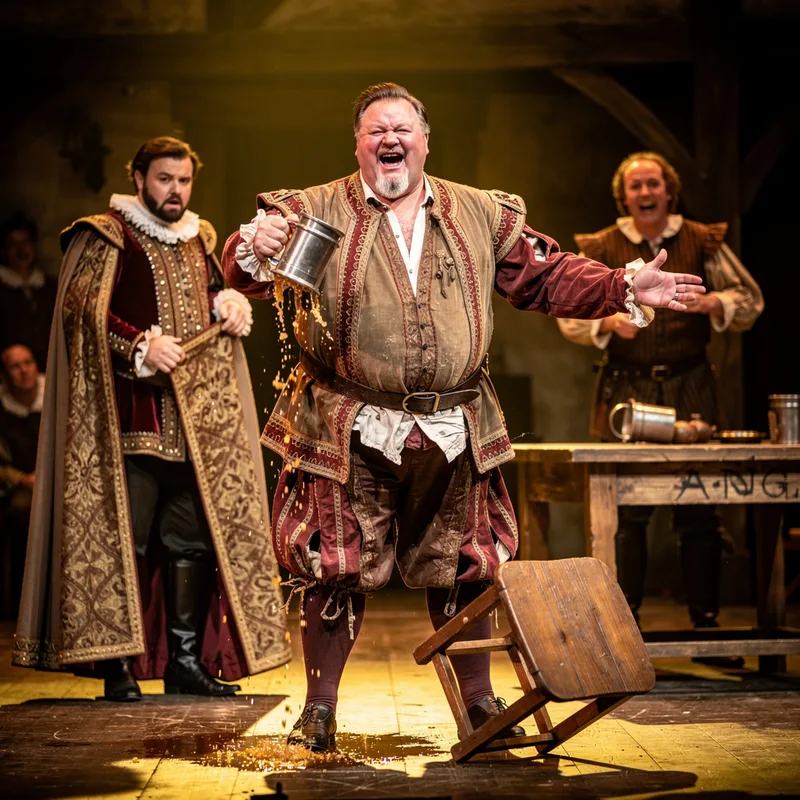
Falstaff
 3
9.9

- proper noun
- /ˈfɔlˌstæf/
- Literature
- His only occasional laughter at Falstaff's antics is surely an ominous sign.
- Falstaff and Hal
Loading YouTube…
Watch on YouTubeAnd he was expecting Hal to look at him and say, Falstaff come, you know, the whole thing.
- And he was expecting Hal to look at him and say, Falstaff come, you know, the whole thing.
Examples
-
Mr. Falstaff bid me give you this.
-
No sign of Falstaff, he got away!
-
- It's him, Ms Falstaff, not me.
-
Let the girl go, Falstaff!
-
Just you and me, Falstaff.
-
But Falstaff had anticipated this move and was waiting for them.
Academic text (1991) -
So, once Hal becomes king, he has to take on the responsibilities of leadership and turn his back on his old, drunken friend, Falstaff.
-
Falstaff is a character loaded with faults, and with those faults which naturally produce contempt.
Academic text (2015) -
In 2 Henry IV, Shakespeare employs it to focus on Hal's choosing between Falstaff and the Lord Chief Justice as his adoptive father on becoming Henry V.
Academic text (2001) -
In Shakespeare's play, Falstaff is depicted as a lovable rogue, always ready for a drink.
Synonyms

 1
8.2
A large funny man in Shakespeare's plays who often brags and drinks
Surface Forms
Etymology
The name Falstaff comes from Shakespeare, who changed an earlier name Oldcastle and likely borrowed the old family name Fastolf from a real English knight. A helpful way to remember Falstaff is to think of a bold, 'stout' sounding name for a large, joking knight, which is why Falstaff is the famous funny, boastful, heavy drinker in Shakespeare's plays.