
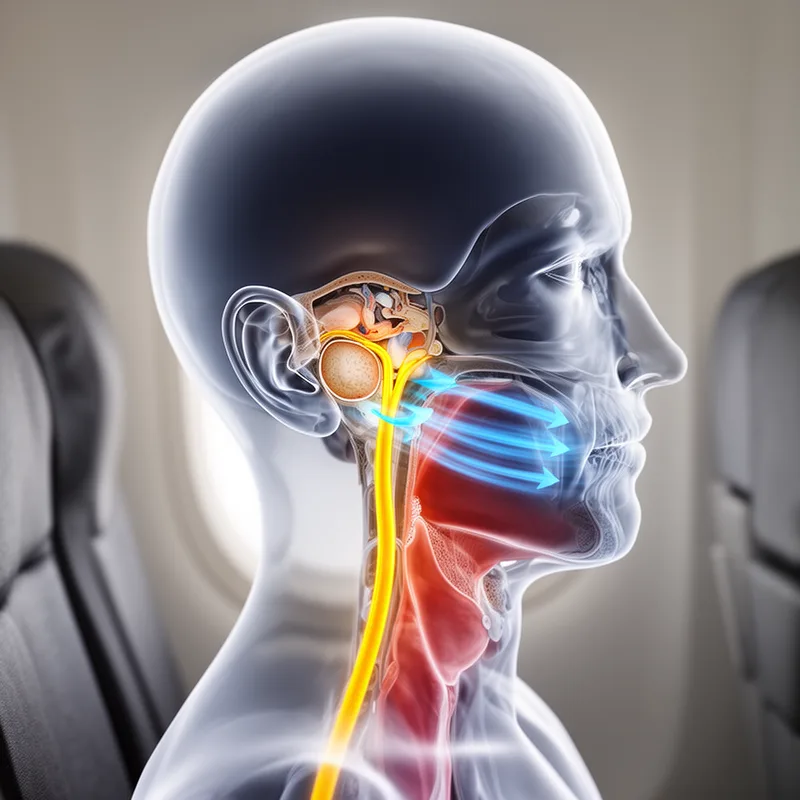
Eustachian tube


 1
6.8
1
6.8
- noun
- /juˈsteɪʃən tuːb/
- Specialized
- Otic involvement in Wegener's granulomatosis may present as otitis media with effusion secondary to eustachian tube obstruction by luminal granulomata.
- Eustachian tube dysfunction
- Eustachian tube occlusion
- Eustachian tube obstruction
Examples
-
This is the Eustachian tube which is a way to vent the air filled middle ear.
-
However, although upper respiratory tract infections are common and often cause eustachian tube obstruction, we very rarely see CSOM as a result.
Academic text (2006) -
None of these children was able to open the eustachian tube with the Valsalva maneuver.
Academic text (2005) -
The remaining four had no recent or ongoing history consistent with ear infection or eustachian tube dysfunction.
Academic text (2008) -
Such investigations could provide us with guidelines for managing children who have known eustachian tube dysfunction.
Academic text (1999) -
In healthy humans, the mastoid area, the middle ear cleft, and the eustachian tube are sterile.
Academic text (2005) -
Such problems may include a tympanic membrane defect or eustachian tube dysfunction.
Academic text (2006) -
Occasionally, pleomorphic adenomas arising from the nasopharynx obstruct the eustachian tubes and cause symptoms of eustachian tube dysfunction.
Academic text (2010) -
When the airplane ascended, my ears popped because the Eustachian tube helps equalize air pressure in the ear.
-
Inflammation in the throat can affect the Eustachian tube, making it difficult for air to pass and leading to discomfort.
Synonyms

A tube that connects the middle ear to the back of the nose to make ear pressure the same
Surface Forms
Morphology
Eustachian + tube
The modifier "Eustachian" is an eponymic, specialist anatomical term with no transparent, compositional meaning for a B1 learner, and knowing the noun "tube" (a hollow cylinder) does not indicate the specific location or function (middle ear ↔ throat, pressure equalization). Because the crucial element is a technical name rather than a descriptive word, the overall expression is not derivable from its parts and is therefore opaque to learners.
Etymology
Eustachian tube comes from an Italian doctor named Bartolomeo Eustachi who first wrote about this small part of the ear. The thin tube links the middle ear to the upper throat and helps 'balance' air pressure so the eardrum feels normal, which is why the name now means that ear-to-throat passage.