
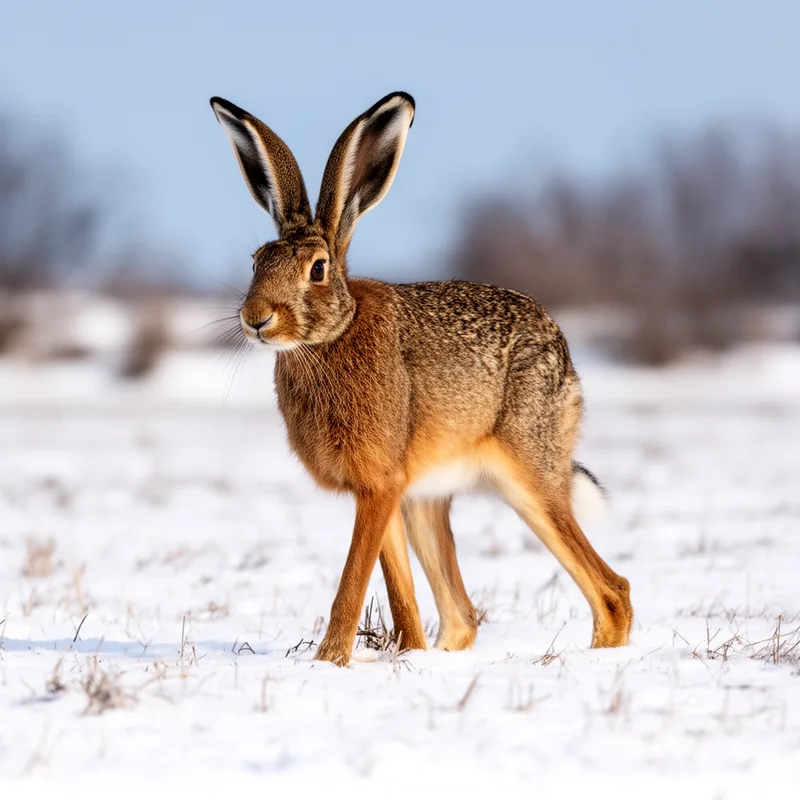
European hare
- noun
- UK
- Unlike the snowshoe hare, the European hare keeps its brown coat throughout the winter.
Examples
-
The European hare is known for its long, powerful hind legs and fast running speed.
-
The European hare is known for its long ears.
-
Scientists track the spread of the European hare in many parts of North America.
-
Many European hares can be seen in the fields.
-
The European hare is known for its long ears and strong legs.
-
In the forest, I spotted a European hare hopping across the path.
-
Farmers often see European hares in their fields during the spring.
Synonyms
A large wild hare from Europe that keeps brown fur in winter
Surface Forms
Morphology
The meaning ('a hare from Europe' / a species of hare associated with Europe) is directly and transparently derived from combining 'European' (connected with Europe) with 'hare' (a long-eared mammal). This is a straightforward compositional noun phrase indicating geographic origin, a pattern that is cross-linguistically common and easily understood by a B1 learner who knows both constituents.
Etymology
European hare simply names the fast, brown hare that originally came from Europe and nearby parts of Asia. Because people used European to show where it came from and to tell this kind of hare from others that turn white in winter, the name now means this particular brown hare.

