
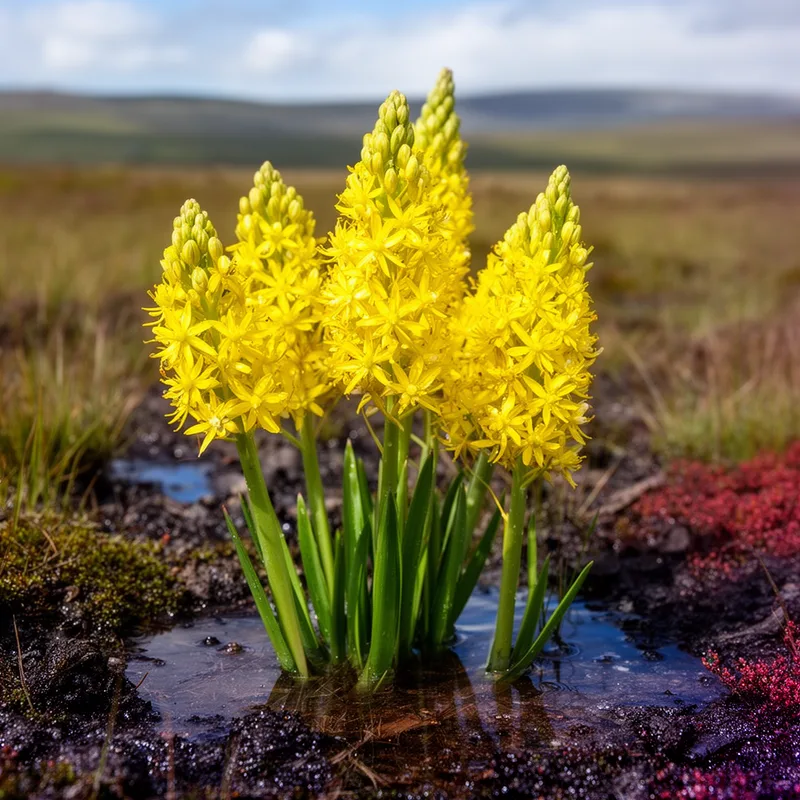
European bog asphodel
- noun
- UK
- The European bog asphodel blooms spectacularly in peat bogs during midsummer across the north of England.
Examples
-
The bright yellow flowers of the European bog asphodel are a notable feature of upland moorland landscapes.
-
The European bog asphodel thrives in wet, acidic soils.
-
Botanists studied the habitat preferences of the European bog asphodel in Scottish wetlands.
-
In spring, the European bog asphodel blooms beautifully.
-
The European bog asphodel is often found in the marshy areas of Scotland, thriving in its natural habitat.
-
During a nature walk, we admired the bright yellow flowers of the European bog asphodel growing in the wetland.
-
In northern Spain, the European bog asphodel can be spotted flourishing among the reeds of the boggy landscape.
Synonyms

A small plant with bright yellow flowers that grows in wet bogs
A plant with bright yellow flowers that grows in wet bogs
Surface Forms
Morphology
The phrase is fully compositional: 'European' (from Europe) + 'bog' (wet peatland) + 'asphodel' (a type of perennial plant) directly yields the meaning 'a species of asphodel that grows in bogs in Europe.' There is no idiomatic or metaphorical shift and the adjective+noun+noun structure is a standard, transparent descriptive pattern that a B1 learner who knows the constituents can infer.
Etymology
European bog asphodel may come from its parts: European (where the plant grows), bog (a 'wet place'), and asphodel (an old word for a yellow meadow flower). Because the plant has bright yellow, star-like flowers and lives in wet bogs across Europe, the name helps you picture the plant and its home.

