
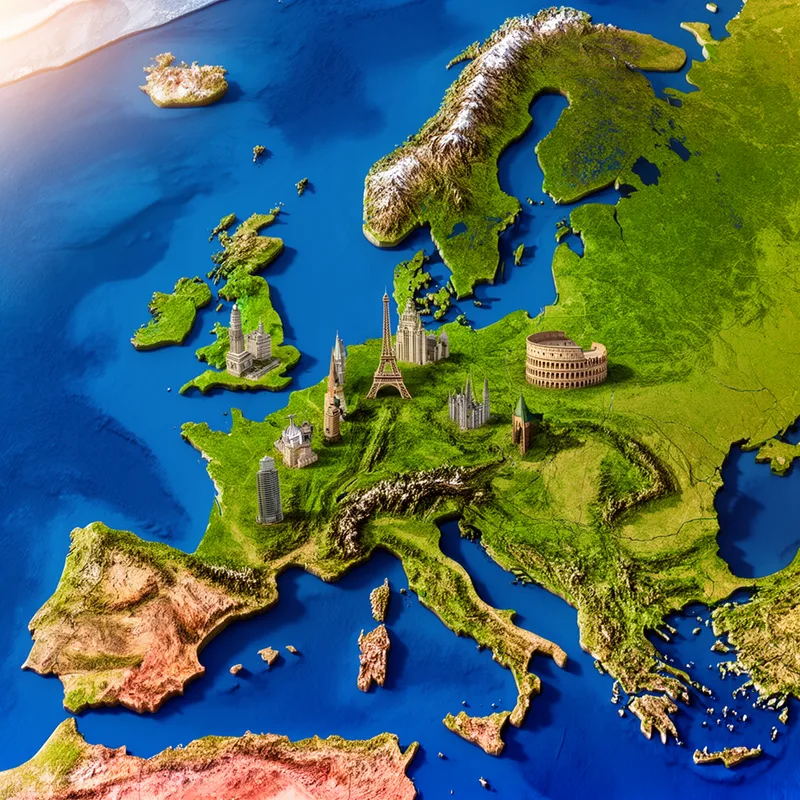
Europe
 ∞
1.0
∞
1.0

- proper noun
- /ˈjʊərəp/
- I traveled across Europe last summer, visiting Spain, France, and Italy.
- countries in Europe
- Eastern Europe
- Western Europe
Loading YouTube…
Watch on YouTubeAnd next week I'm going to Europe for a year.
- And next week I'm going to Europe for a year.
- I didn't realize that Europe was higher risk.
- There's the world of really low growth, that's Europe and China.
- OK, I'm travelling in Europe, I'm a young guy.
- Oh yes, in many parts of Europe there isn't much stone.
- I had the first platform in Europe to buy and sell online.
- I went to Europe with two of my friends.
- Is the food in Europe really different?
- It was the biggest MMA promotion in Europe at that time.
- So I went to Europe with my oldest son and his girlfriend.
- troops to Europe to fight the war.
- He expects America and Europe to blink and then then he wins.
Examples
-
Indeed, after the United States, Europe still holds the world's most advanced military capabilities.
Academic text (2011) -
It's moving west across Europe.
-
I went to Europe with two of my friends.
-
Is the food in Europe really different?
-
How could Europe have done this to itself?
-
We'll move to Europe, and I'll have my baby in France.
-
The obvious solution to all these problems would be for Europe to spend more on defense.
Academic text (2011) -
Well, I came to Europe to sing with my band, but we broke up in Rome before we ever even booked a show.
-
Britain currently has the highest percentage of vegetarians in Europe, about five percent of the population.
Academic text (2011) -
I hadn't been on a vacation in Europe since college.
Compounds
 8
1.1
8
1.1
A region of Europe in the north that includes countries like Norway, Sweden, and Finland


An organization in the United Nations that helps European countries work together on economic matters

- Specialized
The main NATO military headquarters responsible for protecting the area from Norway to Turkey
The NATO headquarters in Europe that gives military advice and leads allied forces
Senior military leader in Europe for NATO who is in charge of all forces there

A day that marks the Allied victory over Nazi Germany in Europe on May 8, 1945
Surface Forms
Etymology
The word Europe may come from Greek parts eur- ('wide') and -ops ('face'), so you can imagine a 'wide face' of land. Another popular idea links Europe to a word for 'sunset' or 'west', so a helpful way to remember it is as the 'land of the setting sun'.