
Euglenaceae
- noun
- /juːˈɡlɛnəˌsiː/
- Specialized
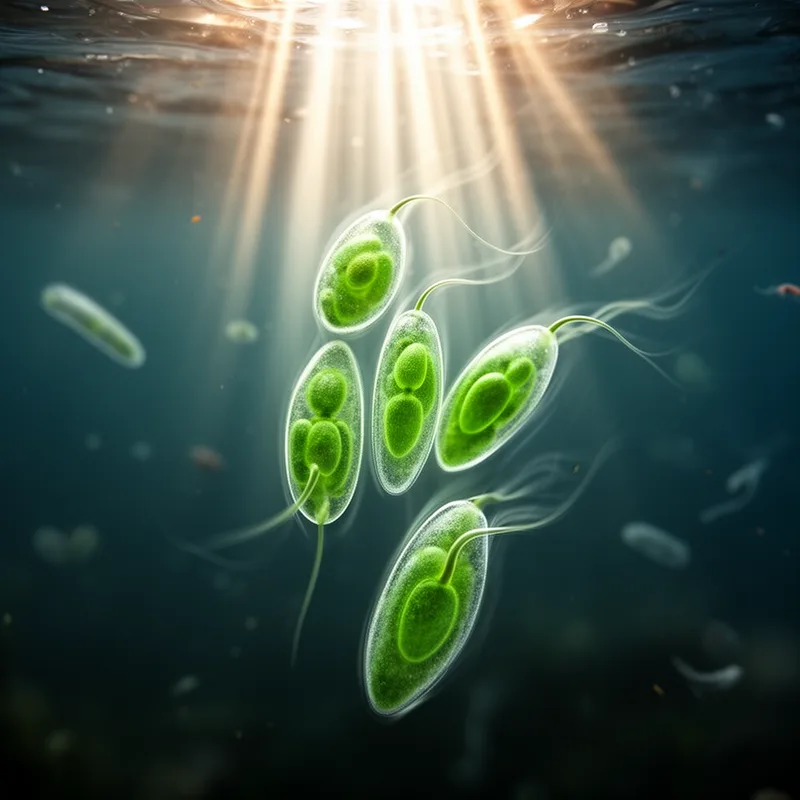
- Many species in the Euglenaceae are capable of both photosynthesis and movement using flagella.
Examples
-
Some freshwater ponds contain members of the Euglenaceae, visible under a microscope.
-
Research on Euglenaceae has contributed to understanding cell biology and photosynthesis.
-
The Euglenaceae family includes various species of green algae.
-
Many researchers study Euglenaceae for their unique movement.
-
Many species in the Euglenaceae are capable of both photosynthesis and movement using flagella.
-
Some freshwater ponds contain members of the Euglenaceae, which can be seen under a microscope.
-
The Euglenaceae family plays an important role in freshwater ecosystems due to their unique characteristics.
Surface Forms
Morphology
Euglenaceae = Euglena (opaque) = Euglena + aceae
The suffix '-aceae' is a specialized botanical family ending unfamiliar to general learners; knowing 'Euglena' alone does not reliably convey 'a family of organisms' to a B1 learner.
Etymology
Euglenaceae comes from the genus name Euglena plus the family ending -aceae, which is used for plant and algae families. The name Euglena comes from Greek parts eu- 'good' and glene 'eye', referring to the small eye-like spot many of these single-celled green algae have, so Euglenaceae is the family of those 'eye' algae.

