

Eugenia caryophyllatum
- noun
- Specialized
- The dried flower buds of Eugenia caryophyllatum are harvested to produce cloves used in cooking and medicine.
Examples
-
The aromatic buds of Eugenia caryophyllatum are harvested to create the popular spice known as cloves.
-
Eugenia caryophyllatum is grown extensively in tropical regions for its highly valued flower buds.
-
Researchers studied the essential oil content extracted from Eugenia caryophyllatum flowers.
-
The Eugenia caryophyllatum tree blooms beautifully in the spring.
-
Many gardeners appreciate the Eugenia caryophyllatum for its fragrant flowers.
-
Eugenia caryophyllatum is known for its fragrant flower buds, which are the primary source of cloves used in various cuisines.
-
In tropical climates, Eugenia caryophyllatum is cultivated primarily for its valuable dried flower buds.
Synonyms

 1
4.9
1
4.9

A tropical evergreen tree whose dried flower buds make the spice
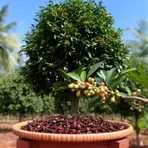
A tropical evergreen tree grown for its dried flower buds that are used as cloves

An evergreen tropical tree that makes small brown flower buds used as a spice and in medicine

Tropical tree grown for its scented flower buds called cloves
Surface Forms
Morphology
Eugenia + caryophyllatum
This is a scientific Latin binomial rather than an ordinary English phrase: the second element 'caryophyllatum' is not a regular English word (not found in the dictionary) and 'Eugenia' functions as a genus name, not a meaningful common noun. Taxonomic Latin names are arbitrary labels and not compositionally interpretable by a B1 learner, so the tree/clove meaning cannot be derived from the parts.
Etymology
Eugenia caryophyllatum is an old scientific name for the clove tree. One popular story says the second part, caryophyllatum, comes from a Greek word meaning 'clove' because the dried flower buds look like little nails or cloves, so the name points to the plant that gives 'cloves'.