

Eucalyptus pauciflora
- noun
- Australian
- The smooth, peeling bark of the Eucalyptus pauciflora makes it easily identifiable in the Tasmanian wilderness.
Examples
-
The Eucalyptus pauciflora thrives in the cold alpine regions of southeastern Australia.
-
Botanists collected samples of Eucalyptus pauciflora for a study on frost resistance in trees.
-
The Eucalyptus pauciflora thrives in cold climates.
-
I saw a beautiful Eucalyptus pauciflora in Tasmania.
-
The Eucalyptus pauciflora, known for its beautiful white bark, grows well in snowy environments.
-
In the national park, the Eucalyptus pauciflora stands out with its distinctive peeling bark.
-
During our hike, we observed a cluster of Eucalyptus pauciflora trees dotting the hillside.
Synonyms
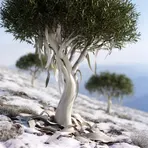
A small Australian or Tasmanian tree with smooth light coloured bark that peels in strips
How Tall
- Specialized
 3
3.5
3
3.5


- Australian
31
2.4
44
1.0
16
2.7
Surface Forms
Morphology
eucalyptus + pauciflora
This is a taxonomic Latin binomial: 'eucalyptus' is transparent but 'pauciflora' is not a common English word (it's Latin for 'few-flowered'), so a B1 learner would only get a partial descriptive sense (‘a few‑flowered eucalyptus’) if they knew the Latin element. The full meaning as a specific species name (snow gum, native to Australia and Tasmania, tree size and bark characteristics) is specialized and not recoverable from everyday English knowledge, making the expression partially but not fully transparent.
Etymology
Eucalyptus pauciflora is a scientific name made of two parts. Eucalyptus comes from old Greek words meaning 'well-covered' because the young flower buds wear a little cap, and pauciflora is Latin for 'few flowers', so the name helps you picture a gum tree with covered buds and only a few flowers.