
Etruscan
 3
9.8

- proper noun
- /ɪˈtrʌskən/
- Historians often study artifacts left by the Etruscans to understand their society.
Examples
-
Nonetheless, long after the Romans annexed the Etruscans in the first century B.C., their culture continued to permeate Roman art, architecture, and religion.
Academic text (2010) -
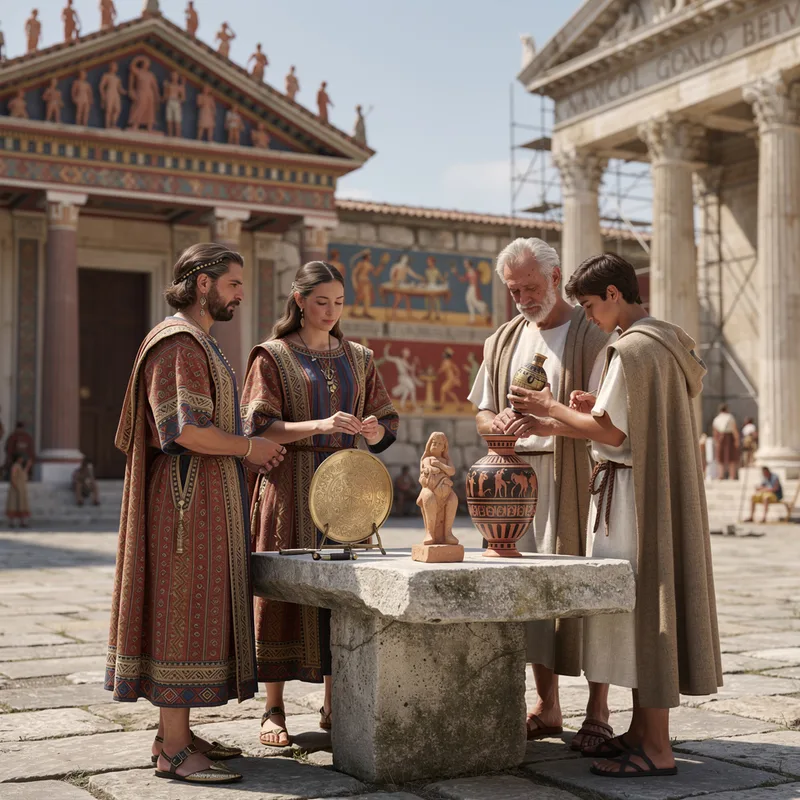
Etruscans celebrating rituals beside the lake.
-
The ancient Etruscans ... had ... a very advanced knowledge.
-
The Etruscans were one of the few peoples of the ancient world who treated women with dignity.
Academic text (2007) -
The Etruscans had already developed extremely refined and spiritual civilization.
-
Another ongoing excavation is also revealing an unprecedented view of the Etruscans' daily lives and building techniques.
Academic text (2010) -
Much of what has been known about the Etruscans comes from their cemeteries, and most surviving artifacts have been grave goods from tombs.
Academic text (2010) -
Ultimately, as Rome conquered Etruscan cities and grew in prestige throughout the Mediterranean, the Etruscans became increasingly Romanized.
Academic text (2010) -
Living in a loose confederation of towns scattered across Etruria, the land between the Tiber and the Arno rivers, the Etruscans dominated much of Italy for five centuries.
Academic text (2010) -
The fifth-century B.C. Greek historian Herodotus believed the Etruscans came from the east, fleeing a famine in Lydia, a kingdom in western Anatolia (modern Turkey).
Academic text (2010)
Surface Forms
Etymology
The word Etruscan comes from the old Roman name Etrusci for the people who lived in a part of Italy called Etruria, and the Greeks called them 'Tyrrhenians', a name also used for the sea near their land. So Etruscan means a person or thing from that ancient Italian people and their culture.