
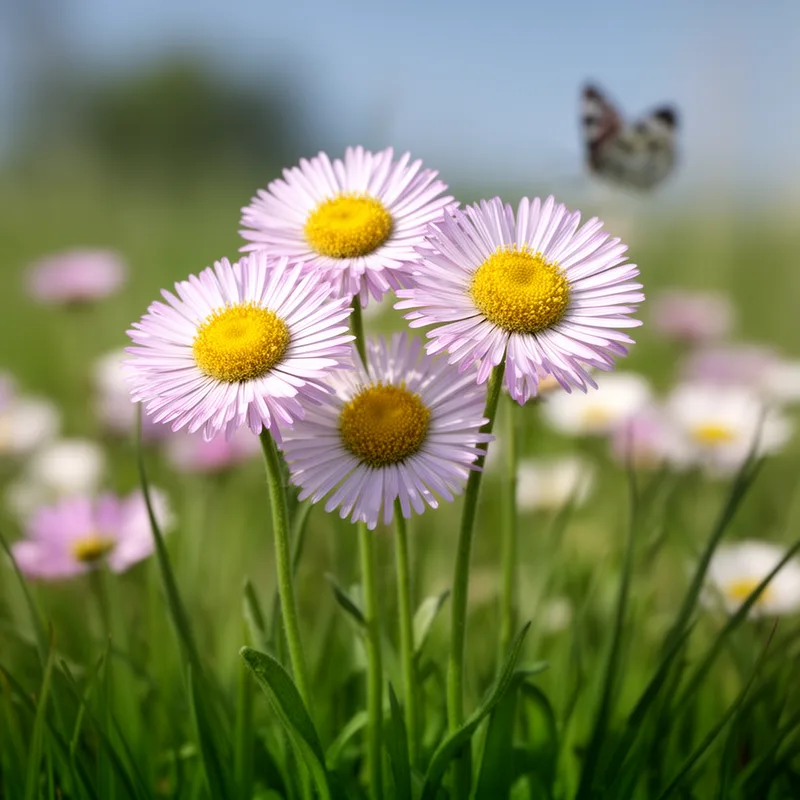
Erigeron philadelphicus
- noun
- /ˌɛrɪˈdʒirən fɪləˈdɛlfɪkəs/
- Specialized
- Gardeners sometimes plant Erigeron philadelphicus for its airy spray of fringed flowers and its appeal to butterflies.
Examples
-
Many pollinators are attracted to the delicate blossoms of Erigeron philadelphicus in meadows and fields.
-
Erigeron philadelphicus blooms in early spring with clusters of tiny white or pinkish flowers.
-
The Erigeron philadelphicus blooms beautifully in the spring.
-
Have you seen the Erigeron philadelphicus in the garden?
-
Erigeron philadelphicus, commonly known as Philadelphia fleabane, thrives in grassy areas with its delicate white and pink flowers.
-
You can find Erigeron philadelphicus growing wild along the roadsides, attracting many bees and butterflies.
-
In the late spring, the garden comes alive with the small blooms of Erigeron philadelphicus, enhancing the landscape with its soft colors.
Synonyms

A small wildflower with daisy-like heads and thin white or pink petals
Surface Forms
Morphology
Erigeron + philadelphicus
This is a scientific Latin binomial combining the genus name 'Erigeron' with a species epithet; a learner who knows 'Erigeron' as a genus of herbs and recognises Latin-derived epithets (philadelphicus ≈ 'of Philadelphia') can infer it denotes a particular species of Erigeron (i.e. a kind of wildflower). However, the specific botanical details (family, appearance) are not predictable from the parts alone and 'philadelphicus' is not a standard English word, so the relation is only partially transparent.
Etymology
Erigeron philadelphicus may come from old Greek words: Erigeron comes from words meaning 'early' and 'old man' because the flowers open early and the fuzzy seed heads look like a tiny white beard, and philadelphicus means 'from Philadelphia'. So the name describes the small wildflower we call 'Philadelphia fleabane'.

