
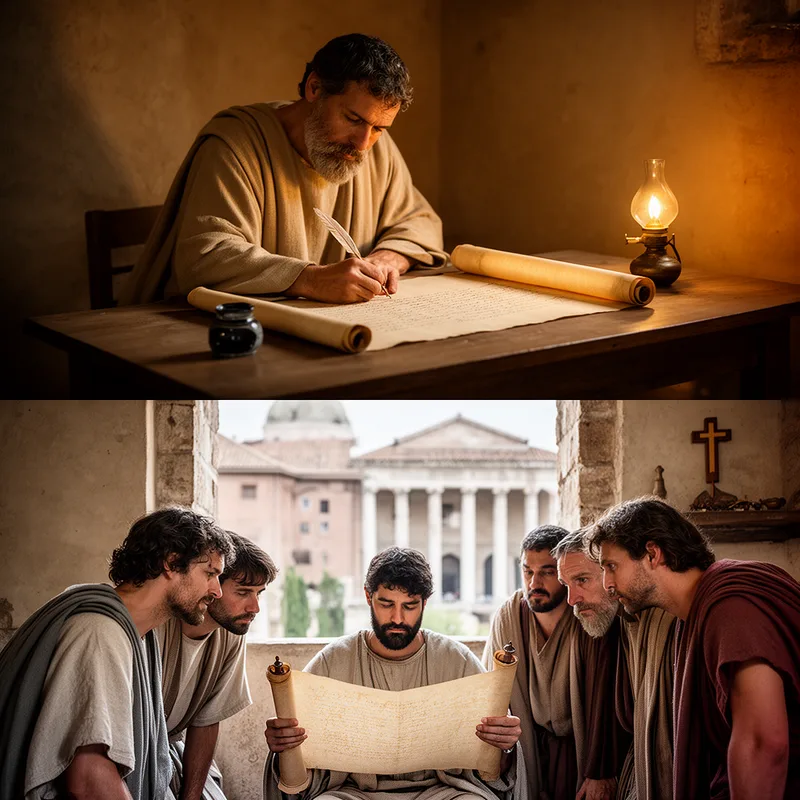
Epistle to the Romans
- proper noun
- /ɪˈpɪsəl tə ðə ˈroʊmənz/
- Literature
- Many scholars study the Epistle to the Romans for its theological insights into faith.
Examples
-
The teachings in the Epistle to the Romans have influenced many Christian doctrines.
-
For him, as St. Paul indicates in the Epistle to the Romans, the earth itself is divine Scripture, and the universe is the ultimate sacred community.
Academic text (1994) -
In his Epistle to the Romans, the Apostle Paul taught, "Let every person be subordinate to the higher authorities, for there is no authority except from God, and those that exist have been established by God."
Academic text (2008) -
By the 1600s, however, Oliver Cromwell and many of the Puritans saw in Paul's Epistle to the Romans chapters 9 to 11 that the destiny of the Jewish people was to be re-ingrafted to the vine of the church.
Blog text (27) -
In the Epistle to the Romans, Saint Paul discusses the concept of sin and redemption.
Synonyms
 103
5.8
103
5.8

A book in the New Testament written by Paul that explains Christian beliefs

A book in the Christian Bible that explains Paul's teachings to Christians in Rome
Surface Forms
Morphology
The title is compositionally transparent: 'epistle' means a letter and 'to the Romans' indicates the addressees (people in Rome), so the overall meaning — a letter addressed to Romans — follows directly from the parts. This is a standard, cross-linguistically common title pattern for biblical books, so a B1 learner who knows the constituent words would understand the MWE's meaning.
Etymology
Epistle to the Romans comes from the word epistle, an old word for 'letter', and Romans, meaning 'Christians in Rome'. It is the long letter Saint Paul wrote to that church to explain Christian beliefs, so today it is the New Testament book where Paul explains his ideas about faith and grace.