
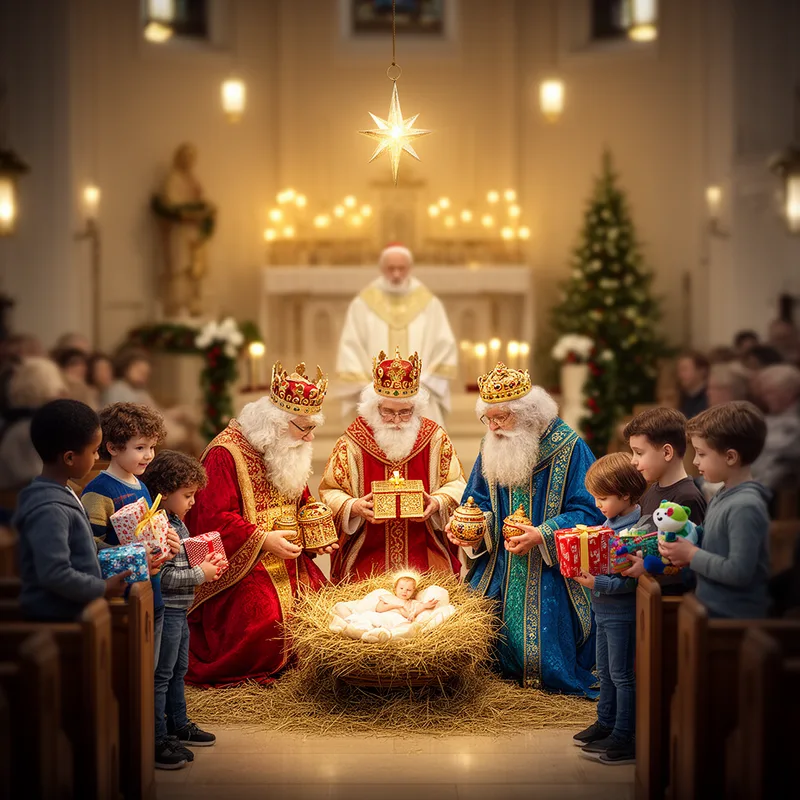
Epiphany of Our Lord
- noun
- /ɪˈpɪfəni əv aʊər lɔrd/
- Many Christians attend church services on the Epiphany of Our Lord to remember the journey of the Magi.
Examples
-
The Epiphany of Our Lord is also known as Three Kings' Day in some cultures.
-
Children in Spain often receive gifts on the Epiphany of Our Lord instead of Christmas day.
-
The Epiphany of Our Lord is celebrated on January 6.
-
Many Christians attend church on the Epiphany of Our Lord.
-
Many Christians attend church services on the Epiphany of Our Lord to remember the journey of the Magi.
-
The Epiphany of Our Lord is also known as Three Kings' Day in some cultures.
-
Children in Spain often receive gifts on the Epiphany of Our Lord instead of Christmas day.
Synonyms
 1
7.2
1
7.2

A Christian festival on January 6 that celebrates the visit of the three wise men to the baby Jesus

A Christian holiday twelve days after Christmas that remembers the visit of three wise men to baby Jesus

A day twelve days after Christmas when Christians remember the visit of the three wise men
Surface Forms
Morphology
The phrase is directly compositional: 'Epiphany' denotes the Christian festival commemorating the Magi's visit and 'of Our Lord' specifies that the festival concerns the Lord (Jesus), so the overall meaning is inferable from the parts. This construction is also cross-linguistically common in Christian contexts (e.g. Spanish "Epifanía del Señor"), making it predictable for learners who know the constituent words.
Etymology
Epiphany of Our Lord gets its name from a word that means 'appearance' because it remembers the moment when the wise men saw the baby Jesus and understood who he was. So today the day celebrates that 'showing' of Jesus to the world and the visit of the Magi.