
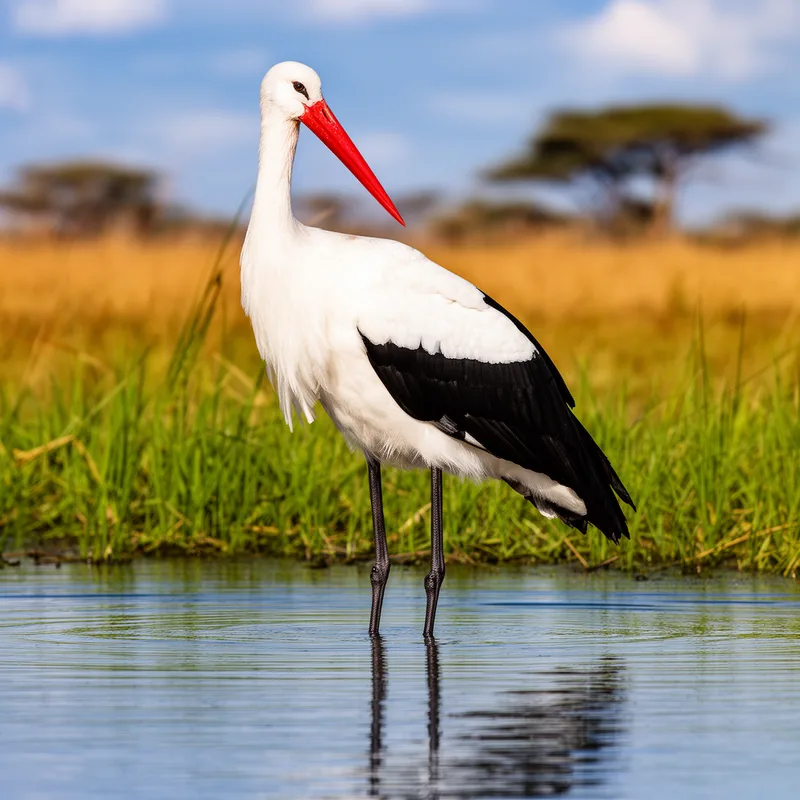
Ephippiorhynchus senegalensis
- noun
- Specialized
- The Ephippiorhynchus senegalensis is a striking sight along the rivers of sub-Saharan Africa.
Examples
-
Researchers observed a pair of Ephippiorhynchus senegalensis nesting near the wetlands.
-
Birdwatchers hope to spot the elusive Ephippiorhynchus senegalensis on their safari tour.
-
The Ephippiorhynchus senegalensis is often seen near wetlands.
-
Have you ever spotted an Ephippiorhynchus senegalensis in the wild?
-
Birdwatchers hope to spot the elusive Ephippiorhynchus senegalensis on their safari tour.
-
Researchers observed a pair of Ephippiorhynchus senegalensis nesting near the wetlands.
-
The Ephippiorhynchus senegalensis is a striking sight along the rivers of sub-Saharan Africa.
Synonyms


 1
9.9
1
9.9
A large black and white stork with a bright red bill and a black band

A large black-and-white stork with a red bill and a black band found in tropical Africa
Surface Forms
Morphology
Ephippiorhynchus + senegalensis
This is a Latin binomial (genus + species) used as a taxonomic label rather than a compositional English phrase, so its common-name meaning ('saddle‑billed stork') is not derivable by a B1 learner from the parts. Even if a learner knew 'Ephippiorhynchus' as a group of large storks and recognised 'senegalensis' as relating to Senegal, interpreting the precise species identity and descriptive features requires specialist/Latin knowledge, making it unpredictable for general learners.
Etymology
Ephippiorhynchus senegalensis may come from old Greek and Latin words: ephippio ('saddle'), rhynchus ('bill'), and senegalensis ('from Senegal'). The name fits the bird because its long red bill with a black band looks like a saddle on its face, so the name points to the stork's look.