
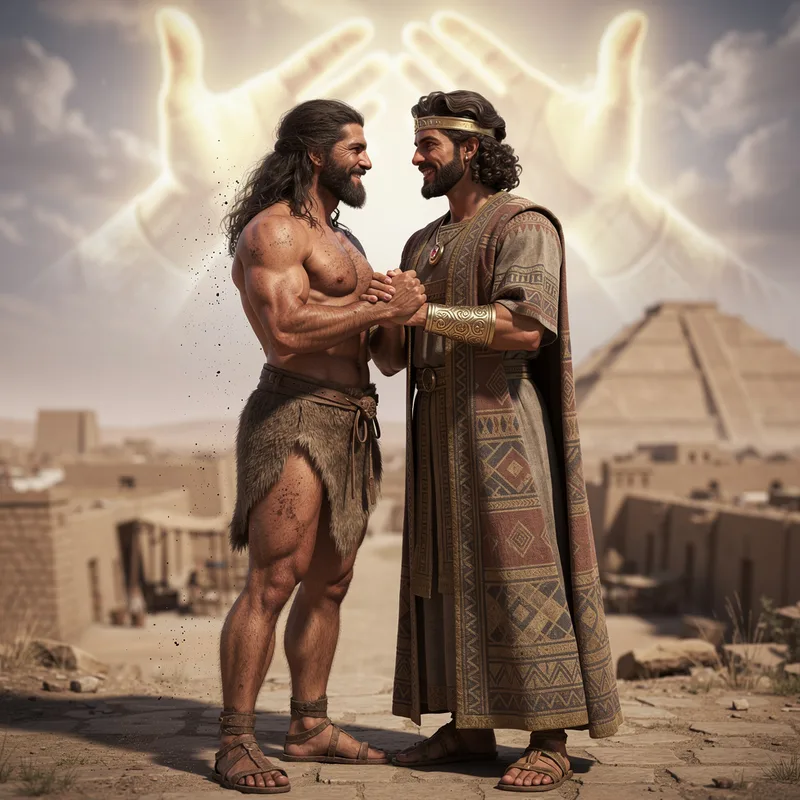
Enkidu
 1
9.9

- proper noun
- Literature
- This story of a god-like tyrant king (Gilgamesh) and an innocent, animal-like man (Enkidu) portrays the ways in which they become humanized through their friendship.
- Enkidu and Gilgamesh
- the death of Enkidu
Examples
-
In Mason's poignant rendition of Enkidu's death, Enkidu's words to his friend, Gilgamesh, reveal to us the depth of attachment and sorrow felt by the dying as they leave the known world.
Academic text (2001) -
When the latter complain to the gods, the ball falls into the netherworld, and Enkidu, Gilgamesh's trusted companion, volunteers to retrieve it.
Academic text (2010) -
And Gilgamesh says, "For Enkidu, my friend."
Fiction book (1994) -
And there, Enkidu saw in this dream, there was no light at all and no joy, and the people were dust and fed on clay.
Fiction book (1994) -
Enkidu is the wild man, hairy and unyoked.
Academic text (2000) -
The selections from Gilgamesh included in Ferry's Of No Country I Know concern the death of Enkidu and Gilgamesh's lamentations for his partner.
Academic text (2000) -
In the Epic of Gilgamesh, Enkidu becomes a close friend and companion to the king of Uruk.
-
When Enkidu fell to the ground, Gilgamesh mourned deeply for his beloved friend.
-
The friendship between Enkidu and Gilgamesh is central to the themes of love and loss in the epic.
Surface Forms
Etymology
Enkidu is a name from ancient Mesopotamia for the wild-made friend of Gilgamesh. A helpful way to remember it is to think of En- as 'lord' and -kidu as 'made from the wild', so the name fits a strong man who was created by the gods to be a companion.