
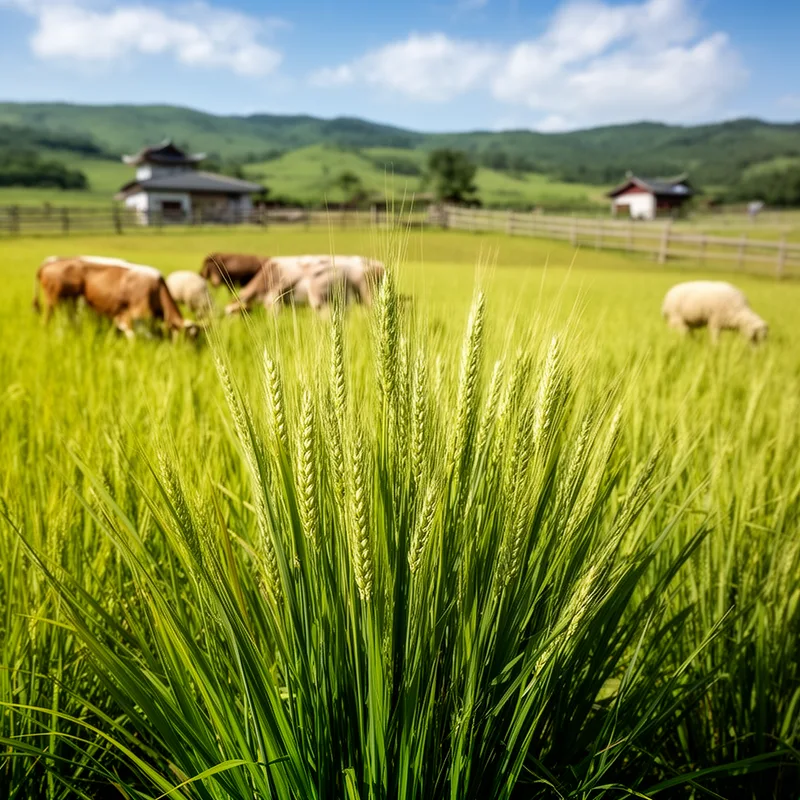
Elymus hispidus
- noun
- Specialized
- Farmers often plant Elymus hispidus for better pasture quality.
Examples
-
Elymus hispidus is valued for its resilience in dry climates and its use in livestock pastures.
-
The agricultural extension recommended planting Elymus hispidus as a reliable fodder crop.
-
Researchers studied the growth patterns of Elymus hispidus to evaluate its suitability for American rangelands.
-
Have you ever seen Elymus hispidus growing in the wild?
-
Elymus hispidus is commonly used as pasture grass in many American farms.
-
Due to its drought resistance, Elymus hispidus is favored by farmers for fodder.
-
Farmers often choose Elymus hispidus to enhance the quality of their livestock feed.
Synonyms

A grass from Asia that farmers grow to feed their animals
A grass from Asia grown for animal feed and to protect soil and sometimes used as a grain crop
Surface Forms
Morphology
Elymus + hispidus
This is a Linnaean binomial combining the genus name Elymus (a group of grasses) with an epithet hispidus; if a learner knows both constituents they can infer it denotes a particular species of Elymus (and, if they know 'hispidus' from Latin, that it has a bristly quality). However, specific information in the dictionary gloss (Asiatic origin, introduction to the U.S., use as pasture/fodder) is not recoverable from the parts alone and botanical naming conventions may be unfamiliar to many B1 learners, so the relation is only partially predictable.
Etymology
Elymus hispidus comes from old Greek and Latin words: Elymus may have been a Greek name for a kind of grass, and hispidus means 'bristly' or 'hairy' in Latin. So the name paints a simple picture of a rough, bristly grass from Asia used for pasture and livestock feed, which explains why the name fits this useful pasture plant.

