

Elizabethan era


 1
6.8
1
6.8
- noun
- /ɪˌlɪzəˈbiːθən ˈɪərə/
- What if Shakespearean literature had died in the Elizabethan era, and that was all there was to Shakespeare—Elizabethans speaking to Elizabethans about things Elizabethan?
Examples
-
The Elizabethan era was a time associated with Queen Elizabeth I's reign (1558-1603).
Blog text (5) -
During the Elizabethan era, when it became politically expedient, Protestant England allied with Barbary states against Catholic Spain.
Academic text (2001) -
To understand Shakespeare, you must study in detail Elizabethan era and so on.
-
For this project, some students chose to modernize their newspapers, while others kept theirs in line with the story's Elizabethan era.
Academic text (2015) -
This is an ongoing series about life in the time of Hamelot - the Elizabethan era - based on information given to us by Kingdom of Hamelot creator Sharon Watts.
Blog text (6) -
Due to the length of Queen Elizabeth's reign, Prince Charles is unlikely to evoke the same sense of anticipation which greeted the young Queen at the dawn of the second Elizabethan era.
-
This is an ongoing series about life in the time of Hamelot—the Elizabethan era—based on information given to us by the Kingdom of Hamelot creator ...
Blog text (6) -
The Elizabethan era is celebrated for its remarkable contributions to literature and drama.
-
Many famous playwrights, including William Shakespeare, flourished during the Elizabethan era.
-
During the Elizabethan era, England experienced significant cultural and economic growth.
Synonyms
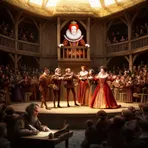
A period of English history during Queen Elizabeth I's rule when literature and drama flourished
Surface Forms
Morphology
The phrase is compositionally built from 'Elizabethan' (relating to Queen Elizabeth I) plus 'era' (a period), so a learner who knows both constituents can infer it denotes the period of Elizabeth I's reign. This adjective+noun pattern for naming historical periods is common cross-linguistically and follows regular English formation, making the meaning readily accessible to a B1 learner.
Etymology
The phrase Elizabethan era comes from Queen Elizabeth I. Elizabethan means 'belonging to Elizabeth' and era means a period of time. Because her rule had great writers and famous plays, the phrase is now used for that special time in English history.