
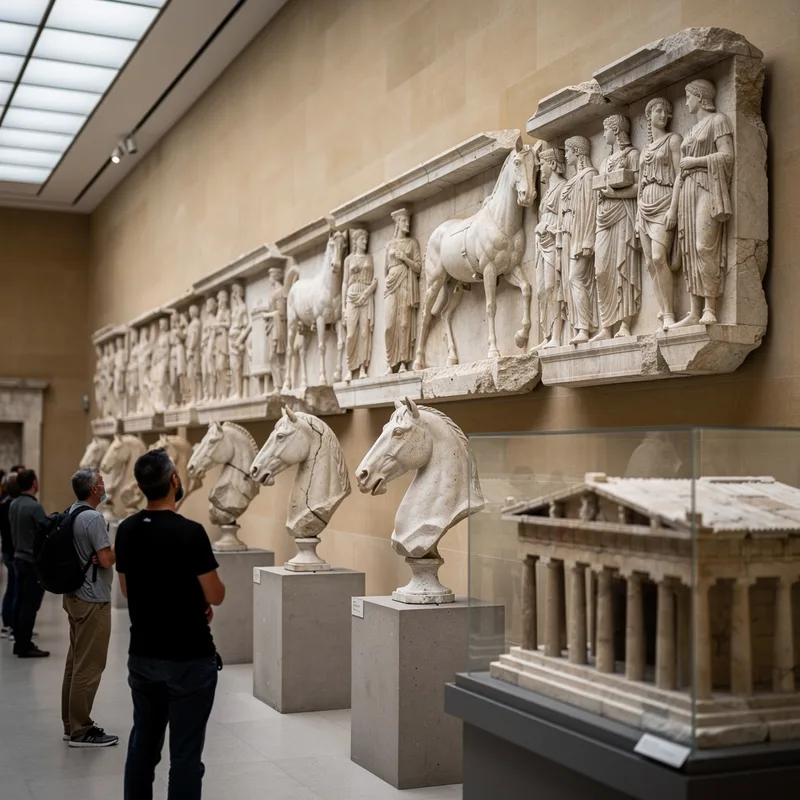
Elgin Marbles
 1
7.9
1
7.9

- noun
- /ˈɛlɡɪn ˈmɑrbəlz/
- Visitors from around the world come to see the stunning Elgin Marbles, a testament to ancient Greek artistry.
Examples
-
One can understand, for example, that the British Museum might be reluctant to return the Elgin Marbles to Athens, and that they would want to keep many of their 200,000-odd African objects.
Academic text (2001) -
At least the Elgin Marbles, pried off the Parthenon two centuries ago and shipped to London, were taken to a place where they could more easily be seen.
Academic text (2011) -
The Malian politicians will want their people to see it as their taking back what was stolen—like those Elgin Marbles in England—but were my pieces stolen?
Academic text (1995) -
The Elgin Marbles, celebrated for their intricate details, are displayed prominently in the British Museum.
-
Many people believe that the Elgin Marbles should be returned to Greece, where they were originally taken from.
Surface Forms
Morphology
Elgin + marble
The phrase is compositionally a proper name + noun, so a learner who knows 'Elgin' as a name and 'marble(s)' as stone sculptures can infer it refers to marbles associated with Elgin. However, the specific historical referent (a particular collection of classical Greek sculptures removed by Lord Elgin and now in the British Museum) is not derivable from the parts alone, so full meaning and cultural/historical significance would remain unclear to a B1 learner.
Etymology
Elgin Marbles is the name for a group of Greek marble statues and parts of the Parthenon that Lord Elgin had 'taken' from Athens to Britain in the early 1800s. Picture those famous marbles being moved to the British Museum — that image explains why the name means that particular collection and why people still argue about returning them.