
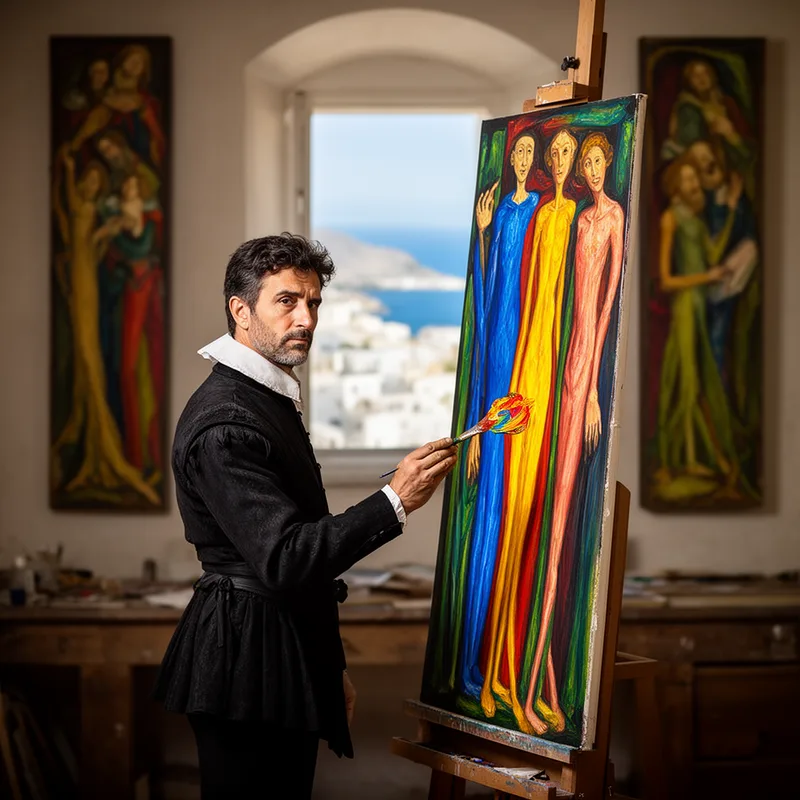
El Greco
 2
8.2

- proper noun
- /ɛl ˈɡrɛkoʊ/
- Many art historians regard El Greco as a pivotal figure in the transition between Mannerism and Baroque art.
- El Greco's work
Examples
-
During my visit to Toledo, I saw several masterpieces by El Greco in the cathedral.
-
El Greco is celebrated for his distinctive style, which profoundly influenced later Western art.
-
The paintings of El Greco often feature expressive faces and vibrant colors.
-
The masterpiece by El Greco is displayed in the museum.
-
Many art historians admire El Greco for his unique style.
-
El Greco is famous for his distinctive style that combines elements of Byzantine and Renaissance painting.
-
In Spain, El Greco's work is celebrated for its emotional intensity and innovative use of color.
Synonyms
 4
9.0
A Spanish painter of Greek origin who painted religious scenes with long figures and bright color
The original name of El Greco, a Greek-born painter in Spain known for long thin figures and strong color
Surface Forms
Morphology
El + Greco
El Greco is a conventional proper name/epithet (literally 'the Greek') rather than a compositional phrase meaning 'Spanish painter'; knowing 'el' and 'Greco' might suggest 'the Greek' but would not allow a B1 learner to infer the referent or the fact that he is a renowned painter. Because the expression functions as a fixed proper name with culturally specific reference, its meaning is not derivable from the constituent words.
Etymology
El Greco comes from the Spanish words El and Greco, which mean 'the Greek'. People called him that because he was a Greek painter who worked in Spain, so today El Greco refers to that famous painter known for long, dramatic figures.