
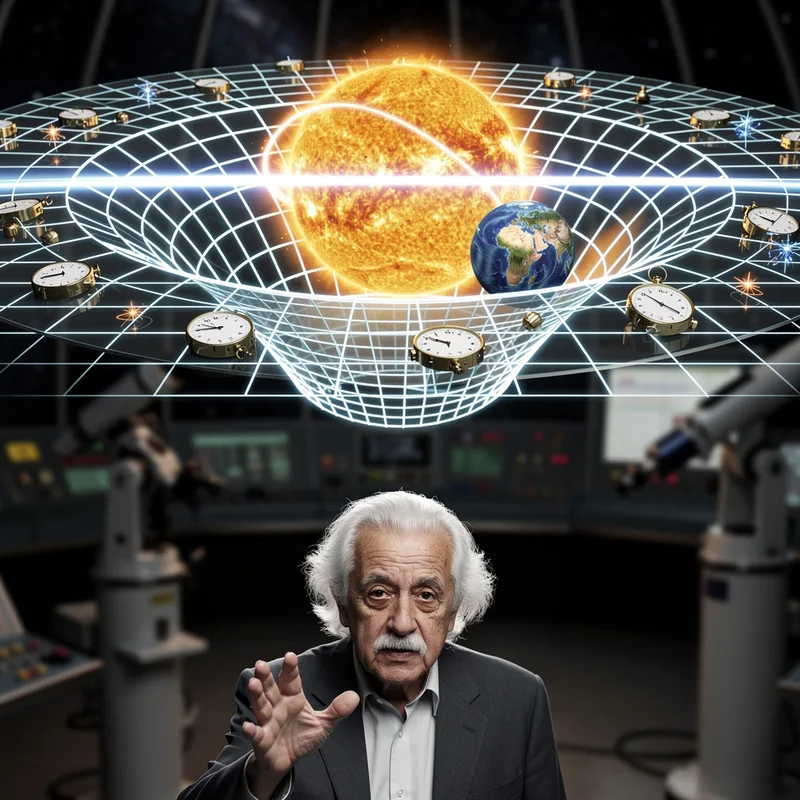
Einstein's general theory of relativity
 1
8.1
1
8.1

- noun
- /ˈaɪnstaɪnz ˈdʒɛnərəl ˈθɪəri əv rɪˈlætɪvɪti/
- Specialized
- Einstein's general theory of relativity explains how gravity is the result of the curvature of spacetime.
- Einstein's general theory of relativity predicts
- According to Einstein's general theory of relativity
- Einstein's general theory of relativity described gravity
Examples
-
Einstein's general theory of relativity (GR), the standard theory of gravity, has passed every high-precision test in the solar system, where gravitational fields are relatively weak.
Academic text (2012) -
The Physics Nobel laureate and astrophysicist Subramanyan Chandrasekhar believed that Einstein's general theory of relativity is the most beautiful creation of human thought.
Academic text (2004) -
Modern physics is divided into two parts: the quantum physics of probability and Einstein's general theory of relativity.
Blog text (25) -
For example, think of an elementary object acted on by the force of gravity, which Einstein's general theory of relativity tells us pervades all space.
Academic text (2004) -
This information will allow us to map the space-time near the horizon and make high-precision tests of Einstein's general theory of relativity.
Academic text (2001) -
Einstein's general theory of relativity, introduced in 1915, describes how matter distorts space-time and produces gravity in the process.
Academic text (2001) -
Preceding page: According to Einstein's general theory of relativity, the two neutron stars comprising the binary pulsar radiate gravitational waves as they orbit about a common center of gravity.
Academic text (2001) -
According to Albert Einstein's general theory of relativity, space itself is free to do what it likes.
-
A solar eclipse provided evidence for Einstein's general theory of relativity by showing the bending of light around the Sun.
Synonyms
 9
6.7
9
6.7
A scientific theory that says gravity is the bending of space and time by heavy things like stars and planets
 3
6.8
3
6.8
A scientific idea that says gravity happens because space and time bend
 3
6.8
3
6.8
A scientific idea that says space and time change depending on speed and gravity

Explains gravity as the bending of space and time by heavy objects
Surface Forms
Morphology
Einstein's + general + theory + of + relativity
The phrase is a straightforward possessive noun phrase naming a scientific theory: combining 'Einstein's' (possessive) + 'general' (broad) + 'theory' + 'relativity' yields the idea of Einstein's broad theory of relativity. A B1 learner who knows the constituents will understand it refers to a theory by Einstein about relativity (even if they lack detailed technical knowledge), and the compositional pattern is cross-linguistically transparent.
Etymology
Einstein's general theory of relativity comes from a simple picture: imagine 'space and time' as a stretched rubber sheet and a heavy mass like the sun as a ball that makes a dip, so other things roll toward it. That's why Einstein said 'gravity' is really objects moving on curved 'space and time', and why the theory explains effects like light bending and black holes.