
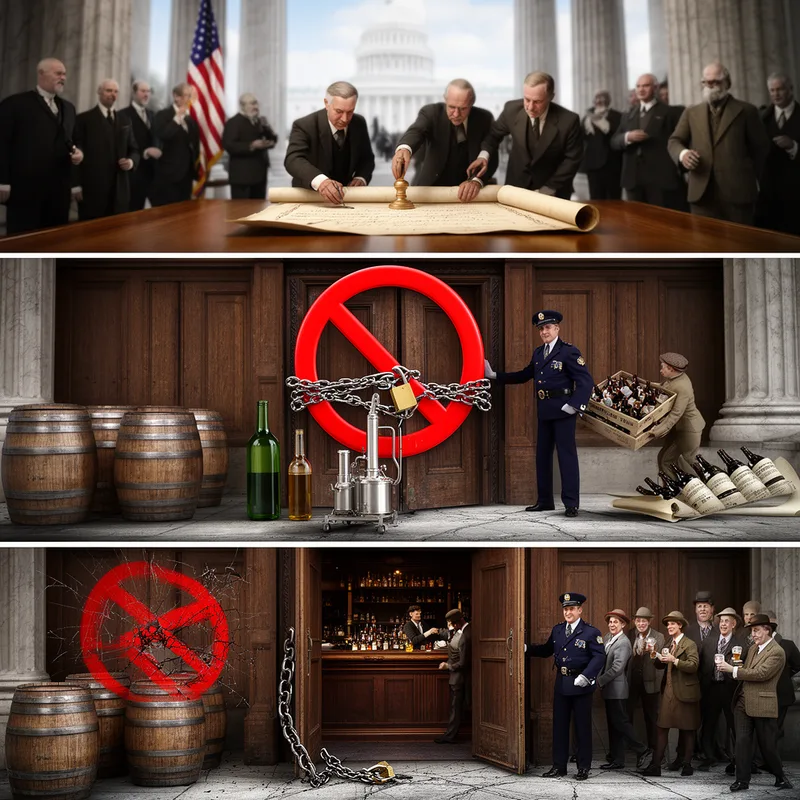
Eighteenth Amendment
- noun
- /ˈeɪˌɡθinθ əˈmɛndmənt/
- Formal
- Many believe that the Eighteenth Amendment was a significant turning point in American social policy regarding alcohol consumption.
Examples
-
The passage of the Eighteenth Amendment in 1920 marked the beginning of Prohibition in the United States.
-
True, the state may not have, and has not, passed any legislation in aid of the Eighteenth Amendment, but from that we do not infer that general words used in her statutes must be interpreted as excepting crimes which are equally crimes, though not forbidden by her express will.
Academic text (2018) -
Before the enactment of the Eighteenth Amendment, for example, Congress attempted to compartmentalize liquor regulations along state lines.
Academic text (2002) -
Take the Fifteenth and Eighteenth Amendments, which may actually have been opposed by a majority of Americans (n293), or the Twenty-Seventh Amendment, whose ratification process spanned more than two centuries.
Academic text (2010) -
Despite such reservations among social work supporters of prohibition and documented evidence that in many areas it had been successful in reducing alcoholism, poverty, crime, and unemployment, the Eighteenth Amendment was repealed by Congress in 1933, an event that sparked widespread popular acclaim for the new Roosevelt administration.
Academic text (2009) -
Due to the Eighteenth Amendment, the manufacture and sale of alcoholic beverages were illegal until its repeal in 1933.
Synonyms
A law that banned making, selling, and moving alcoholic drinks in the United States from 1920 until 1933
Surface Forms
Morphology
The phrase is compositionally clear: 'eighteenth' (an ordinal) + 'amendment' (a formal change to a law or constitution) lets a B1 learner infer it names the 18th formal modification. However, the specific historical content (that this particular amendment prohibited alcohol) is encyclopedic and not derivable from the constituents, so the full meaning is not predictable.
Etymology
Eighteenth Amendment was the eighteenth change to the U.S. Constitution that made the making and selling of alcohol illegal and started the era called 'Prohibition' with secret bars and bootleggers. So, the phrase refers to the law that 'banned alcohol' in the United States from 1920 until it ended in 1933.

