
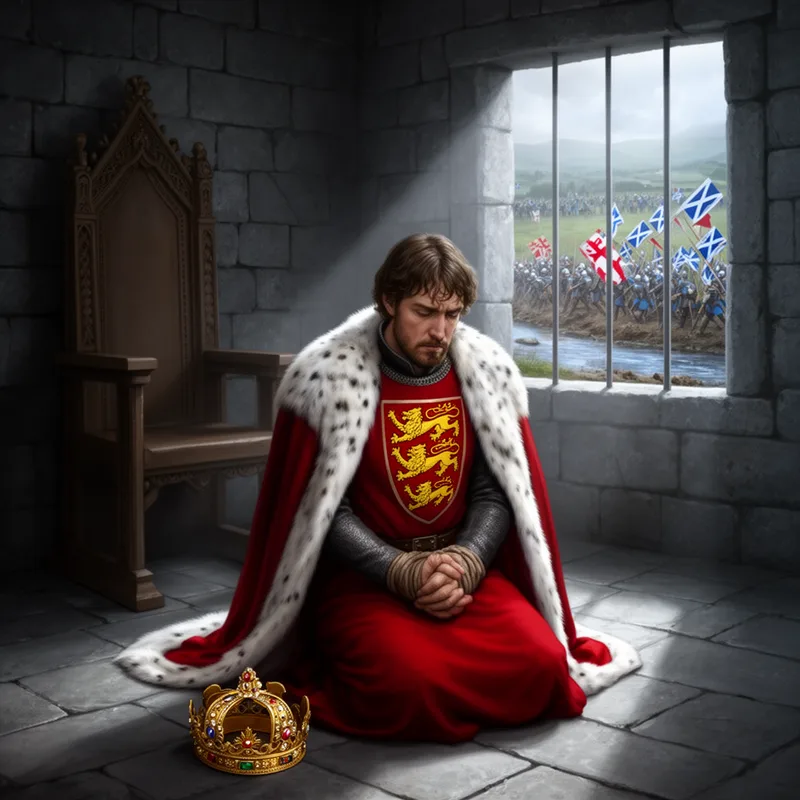
Edward II
 1
8.2

- proper noun
- The King of England, Edward II, ruled from 1307 until his deposition in 1327.
- the death of Edward II
Examples
-
Top: Edward III's letter to his cousin Hereford dated September 25th, 1327, concerning the death of Edward II.
Academic text (2010) -
Above: The tomb of Edward II in Gloucester Cathedral.
Academic text (2010) -
The details of the fake death of Edward II first appeared in 2005 in The English Historical Review.
Academic text (2010) -
The one major exception that I have come across is the death of Edward II.
Academic text (2010) -
So the basis for everyone believing in 1327 that Edward II had died was that single message from Lord Berkeley.
Academic text (2010) -
In strictly methodological terms, the conclusion that Edward II did not die in 1327 is straightforward.
Academic text (2010) -
Bishop Orleton was drawing on a tried and tested means of weakening a political figure, one he had used before when he accused Edward II of sodomy in October 1326.
Academic text (2010) -
Another person who believed Edward II was still alive and being held secretly at Corfe Castle from 1327 to 1330 was Lord Pecche, the custodian of that castle until 1329.
Academic text (2010) -
Many historians discuss the defeat of Edward II at the Battle of Bannockburn in 1314.
-
The reign of Edward II was marked by conflict with Scotland and internal strife.
Surface Forms
Morphology
Edward + II
The form is compositionally transparent insofar as 'Edward' (a personal name) plus 'II' (Roman numeral two) yields 'Edward the Second', so a learner who knows both constituents and Roman numerals can recognize it as the second person named Edward. However, the specific encyclopedic information (that this Edward was King of England from 1307–1327 and the events mentioned) is not derivable from the parts, so the expression offers partial but not full understanding without background knowledge.
Etymology
Edward II was king of England from 1307 to 1327 and is often remembered for a famous defeat at the Battle of Bannockburn, where the Scots beat his army. He was later forced from the throne and died in prison, so people today think of him as a weak, troubled ruler.