
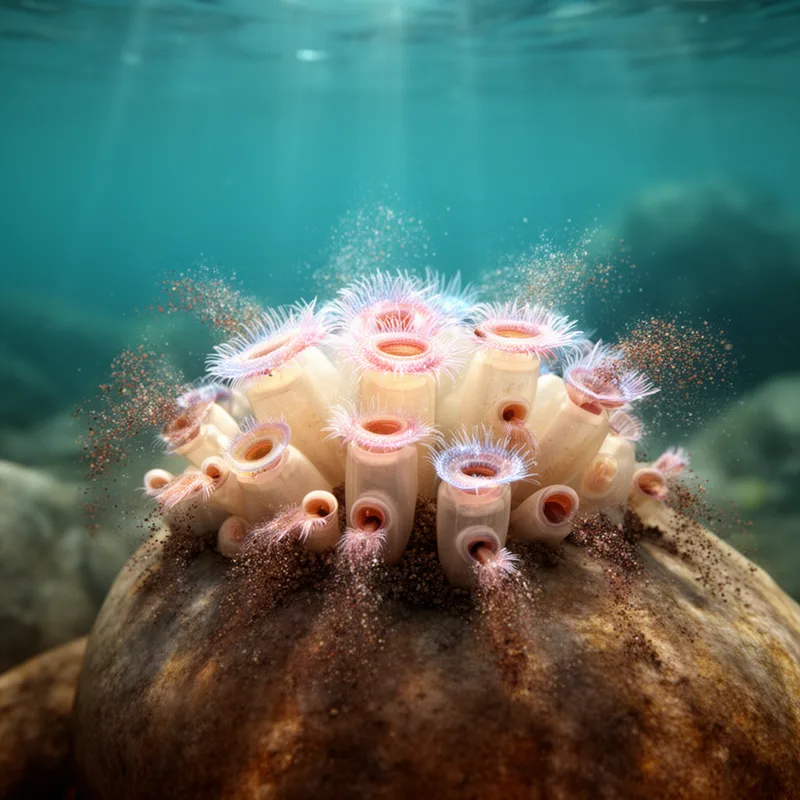
Ectoprocta
- noun
- /ˌɛktəˈproʊktə/
- Specialized
- The reef was covered with colonies of Ectoprocta, creating a delicate lace-like pattern.
Examples
-
Specimens of Ectoprocta are commonly found in both marine and freshwater environments.
-
Researchers are studying the evolutionary relationships between Ectoprocta and other aquatic invertebrates.
-
The Ectoprocta are fascinating creatures found in marine environments.
-
Did you know that Ectoprocta can form large colonies?
-
Researchers are studying the evolutionary relationships between Ectoprocta and other small aquatic invertebrates.
-
Specimens of Ectoprocta are commonly found in both marine and freshwater environments, indicating their adaptability.
-
The reef was covered with colonies of Ectoprocta, offering a habitat for various marine organisms.
Synonyms


 1
9.9
1
9.9
Small water animals that live in colonies attached to rocks or plants and filter food from water
 1
9.9
1
9.9
A small water animal that lives in groups and looks like moss

A group of small water animals called moss animals that live in colonies and filter food

A group of small water animals that live together in colonies in seas and rivers

A small water animal that lives attached to rocks and has feeding tentacles with the anus outside them
Compounds
- Specialized
A group of small water animals called moss animals that live in colonies and filter food
Surface Forms
Morphology
Ectoprocta = ecto + procta
The term is a technical scientific compound built from Greek combining forms (ecto- 'outside' + proct- 'anus') that are not productive standalone English words for the average learner, so the meaning is not derivable by a B1 learner from common English vocabulary.
Etymology
Ectoprocta comes from Greek parts ecto- 'outside' and procta 'anus'. So the name fits these small water animals because their 'anus' is 'outside' the ring of tentacles.