

Echinus esculentus
- noun
- Specialized
- In some coastal regions, Echinus esculentus is considered a delicacy and harvested for food.
Examples
-
Marine biologists are studying the population decline of Echinus esculentus in recent years.
-
The spiny shell of the Echinus esculentus can often be found washed up on rocky beaches.
-
The Echinus esculentus is a popular delicacy in coastal regions.
-
Many chefs enjoy cooking with Echinus esculentus for its unique flavor.
-
In some coastal regions, Echinus esculentus is considered a delicacy and harvested for food.
-
Many chefs enjoy cooking with Echinus esculentus for its unique flavor and texture.
-
The soft, edible flesh of the Echinus esculentus is often served in seafood dishes.
Synonyms

 14
4.9
14
4.9

A small sea animal with a round spiny shell on the ocean floor
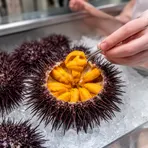
A small sea animal with spikes whose soft parts people eat, like uni
Surface Forms
Morphology
Echinus + esculentus
This is a Latin binomial (scientific) name made of non-English lexical items not found in an English learner's dictionary; a B1 learner who only 'knows the constituent words' as presented would not be able to infer 'edible sea urchin' from them. While the Latin roots roughly correspond to concepts (e.g., esculentus ≈ edible, Echinus ≈ urchin), these are technical/cognate forms not accessible to most B1 learners, so the meaning is not transparently derivable.
Etymology
The name Echinus esculentus comes from old Latin words. The part echinus means 'hedgehog' because the shell has many sharp spines, and esculentus means 'edible'. So the name paints the picture of an 'edible hedgehog of the sea' and explains why this spiny sea urchin is eaten.